The support teams don't have a data problem.
They have trouble accessing their data quickly and efficiently.
They already have data sets. Patterns. Dashboards. Exports. Sometimes even layers of insights.
And yet, the same frustration creeps in: “Yes, but what are customers really saying? Why have leads gone up today?”
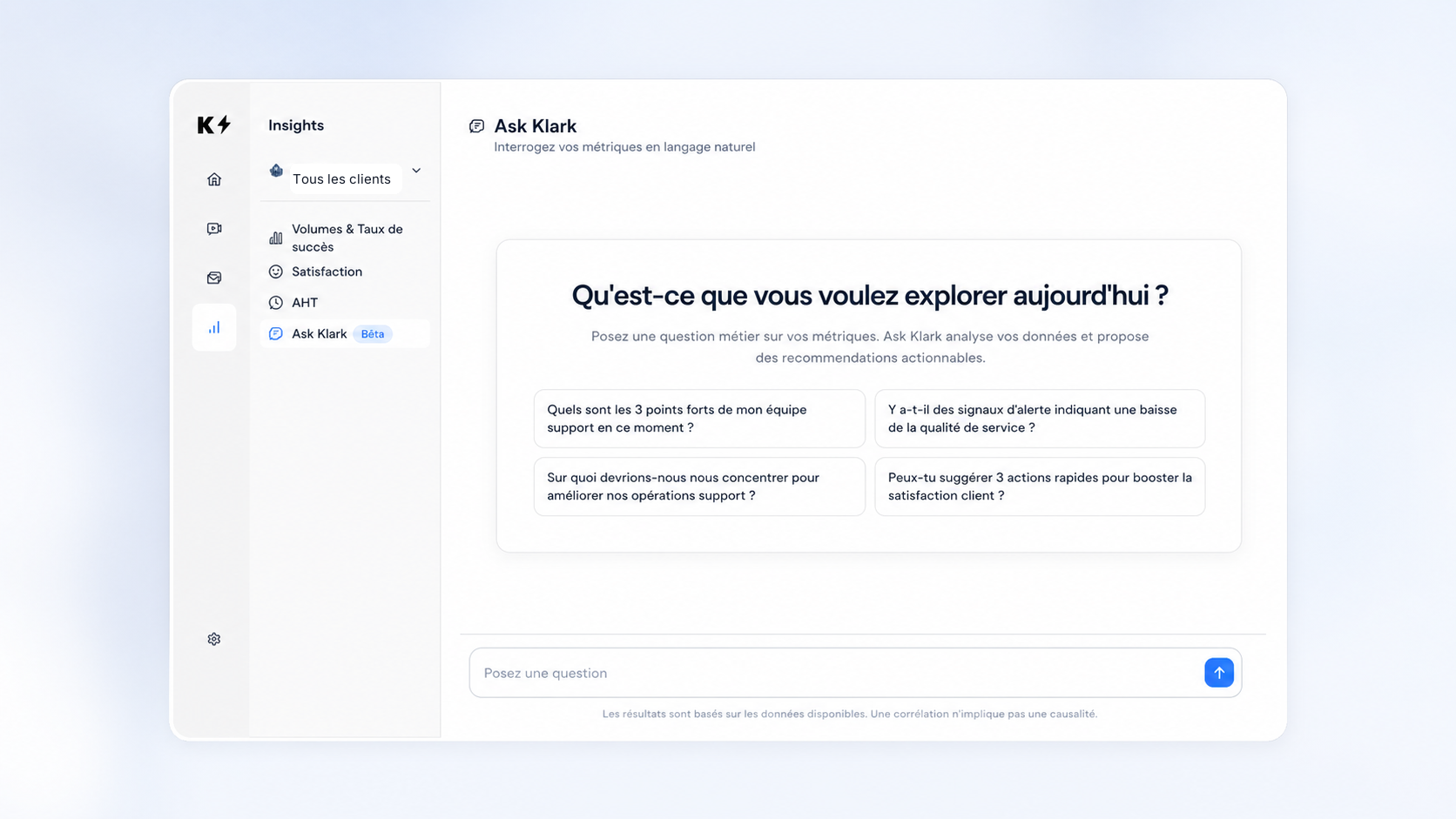
That's exactly what Ask Klark is all about.
Not just a gimmick. Not just another chatbot. But a new interface between a care team and its actual patients.
In many support teams, analysis is fragmented.
Quantity exists. Quality, much less so.
We know how many tickets are open. We know what issues are coming up. We know (sometimes) which products are seeing a surge in volume.
But as soon as you have to answer a question that’s a bit practical or down-to-earth, things get complicated:
The problem isn't that there isn't any information.
The problem is that there are too many of them, and you often have to manually reconstruct the correct query.
Ask Klark changes one simple thing: the interface.
Instead of switching between dashboards, exports, filters, and partial views, the team can ask a question directly.
And it makes a much bigger difference than it seems.
Because a good analytics interface isn't just for displaying numbers. It's designed to bridge the gap between an operational question and an actionable answer.
Typical examples:
In other words: we’re moving from a static view to a queryable layer.
And that's where things get interesting.
Early feedback points in the same direction.
When a team takes on the Ask Klark challenge, they’re not just asking for a nicer-looking summary. They’re asking for a return to the field.
Not only that:
But also:
These quotes and feedback from the field are an excellent way to understand what’s going on, but they’re also a great way to verify the numbers before jumping to conclusions or making a hasty decision.
In this age of AI, a serious support team doesn’t just want an AI layer that “seems to be right.” It wants a tool it can query, audit, and challenge.
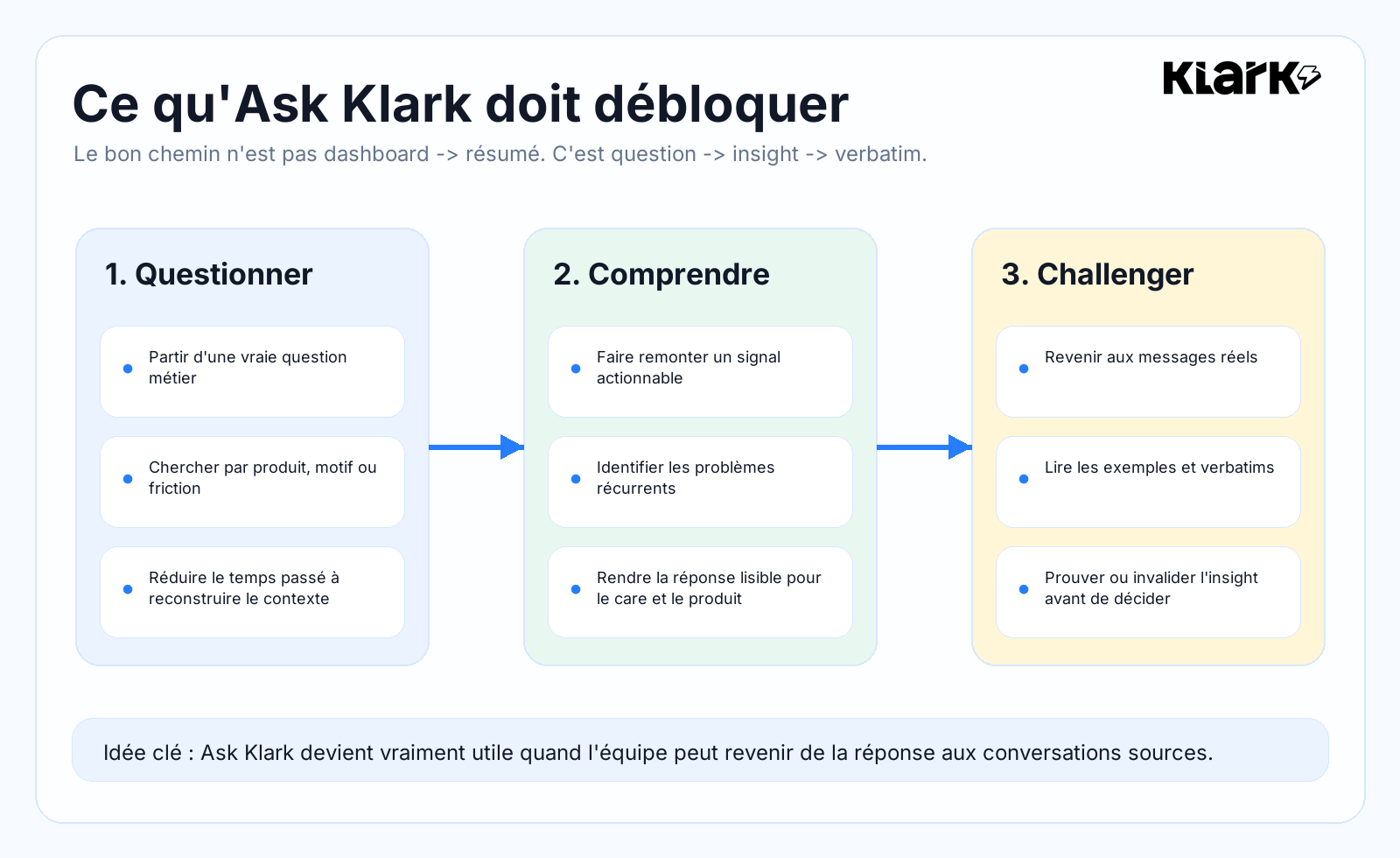
And this is where we need to be clear: today, the real goal isn't just to summarize insights more effectively.
The real goal is to link Ask Klark to the verbatim transcripts.
Because a macro response is valuable.
But a macro response combined with the ability to go back to the actual messages—that’s when we start getting into something much more useful.
Why?
Because many decisions regarding support, products, or operations aren't made based on a dashboard alone.
They are taken when you can make a round trip between:
Without that, we're just stuck with decorative insights. But with it, we're moving into actionable insights!
A support team doesn't need yet another tool telling them that “returns are on the rise for package deliveries.”
She needs a system that allows her to respond more quickly to questions such as:
When this cycle accelerates, the consequences are very real:
And most importantly, it saves us time so we can focus on doing things that really make a difference
Ask Klark isn't interesting because it lets you chat with data “like ChatGPT.”
That's not a product shot. It's a demo.
Ask Klark becomes useful if three conditions are met:
Otherwise, we’ll stick to a pleasant but light-hearted conversation.
The right level of ambition is higher.
When it comes down to it, that's what this is really about.
Good AI support isn't just about responding to customers faster. It should also help teams understand what they're dealing with more quickly.
In this regard, Ask Klark opens up an important avenue because it has the potential to serve as the connecting layer:
In a modern platform, that's exactly the kind of interface that matters.
Support teams don't need yet another dashboard.
They need a layer they can query.
A layer capable of addressing a real business question. A layer capable of being challenged. A layer capable of tracing back to actual conversations when decisions need to be made.
That’s exactly why we launched Ask Klark.
If you’d like to see how Klark is already integrating co-pilot features, automation, and agent-based AI into its support system, you can also read our article on AI in customer service, our guide to chatbots, or our perspective on agent-based AI for customer service.