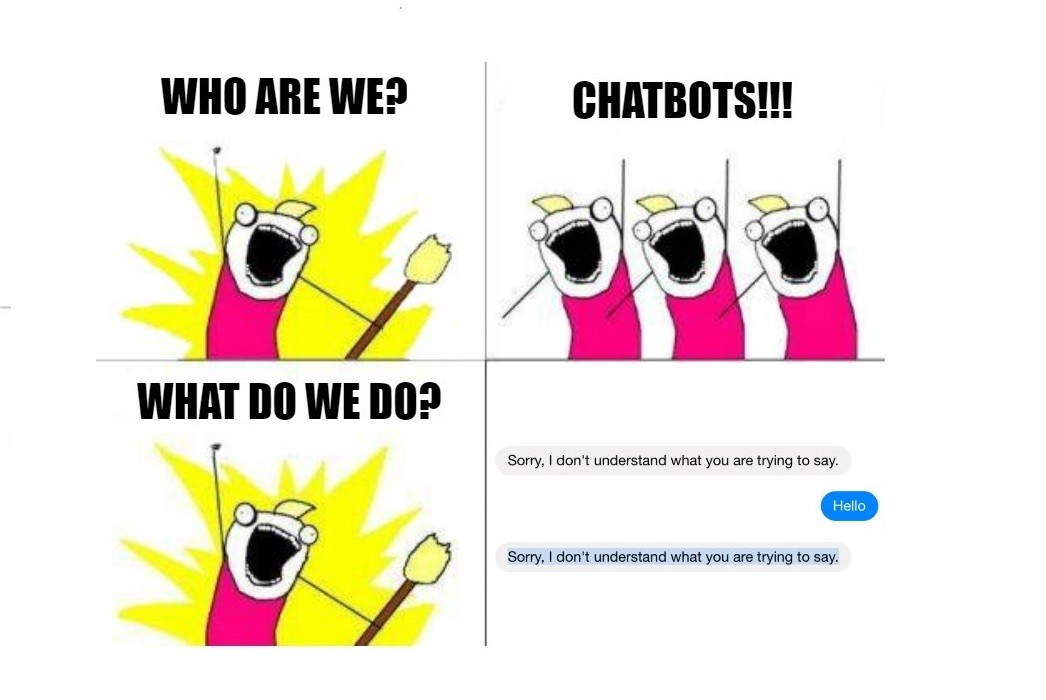
Your chatbot responds "I don't understand your request" for the third time. 🤔
The customer runs away. They won't be coming back.
Millions of consumers experience this scenario every day. And it's not a technology problem. It's a technological generation problem.
Traditional chatbots have been very useful. But in 2026, a new approach to customer service is emerging: agentic AI. It no longer just responds. It acts, consults, and decides. And it puts human contact back at the center, where it really matters.
In this article, you will understand why agentic AI represents a real break from traditional chatbots, how it works in practice in customer service, and what it changes for your teams and your customers. Let's get started! 🚀
A classic chatbot is a reactive tool. It waits for a question. It searches its knowledge base. It gives a predefined answer. If the question is not in the script, it gives up.
Agentic AI works differently. It perceives the context of a conversation, reasons about what it needs to respond correctly, and then acts autonomously to obtain the information and construct an accurate response.
In plain English?
A customer asks, "Where is my order?" The agentic AI does not search through FAQs. It consults the customer's order system in real time, retrieves the exact delivery status, queries the carrier if necessary, and responds with accurate data. Without human intervention. In a matter of seconds.
That's the difference between an assistant who reads a script and an assistant who gets the job done.
Key features of agentic AI:
It is tempting to view agentic AI as "a smarter chatbot." This is a framing error. These are two fundamentally different generations of tools.
What this means for customer service:
A traditional chatbot might tell you "your order is being processed" because that's the default response. Agent-based AI tells you "your package left the warehouse this morning at 9:14 a.m., it is currently in Lyon and will be delivered tomorrow between 10 a.m. and 1 p.m." because it has just checked.
This difference may seem insignificant, but for a customer waiting for an important package, it changes everything.
The figures speak for themselves. The agentic AI market is expected to grow from $7 billion in 2025 to $93 billion in 2032. This growth is not speculative. It responds to real and urgent business needs.
📈 After-sales service volumes are skyrocketing, but teams are unable to keep up.
82% of customer service managers note that customer expectations are constantly increasing. Teams are overwhelmed. Recruiting is not always possible or desirable. Agent AI handles repetitive ticket volumes to free up humans to focus on complex cases.
💰 The cost of wrong answers is massive
A customer who receives a generic response to a specific question about their order is a frustrated customer. 64% of customers say they are unable to get help or resolve their issue through their supplier's customer service, and vague responses remain the number one source of frustration. Every failed response is a risk of losing a customer.
🚀 Intelligent automation becomes accessible
Two years ago, deploying an AI agent required months of integration and dedicated technical teams. Today, plug-and-play solutions allow you to connect an agentic AI to your existing tools in just a few hours. The barrier to entry has dropped dramatically.
"Where is my order?" queries account for up to 40% of customer service tickets in e-commerce. These are precisely the cases where agentic AI excels, and where traditional chatbots most often fail.
Cisco predicts that by 2028, nearly 68% of customer service interactions will be handled end-to-end by agentic AI. Companies that fail to anticipate this shift will fall behind and struggle to catch up.
In a customer service department, an agentic AI analyzes the request, consults the company's data, and can perform actions automatically. Here's how this process works in practice.
Here is what happens in practice at each of these stages.
When a customer sends a message, the AI analyzes the entire conversation, not just the last sentence. It understands that this is a question about a specific order, that an order number may have been mentioned, and that specific data is needed to respond correctly.
This is where everything happens. The AI decides for itself whether it needs additional information to respond. If so, it chooses which tool to query: the internal command system, the carrier's tracking service, or the customer history in the CRM. If the question does not require external data (for example, "What are your hours?"), it responds directly.
The AI calls up the configured data sources, known as "tools" in the technical architecture. It can simultaneously consult the status of an order in the customer back office and tracking information from the carrier (USPS, FedEx, UPS, etc.). This third-party information is crucial: at Klark, the integration of external tracking data improves the accuracy of AI responses by at least 20% compared to AI that only has internal data.
Armed with real data, AI composes a precise, personalized, and useful response. Not a template. Not a copy-paste. A response built from the real facts of the customer's situation.
Every interaction is data. Agentic AI continuously improves, identifying the types of questions it handles well and those that require escalation to an advisor.
Agentic AI can handle many tickets completely independently. But certain situations require an advisor to remain in control: an unhappy customer, a sensitive request, or a case that falls outside standard procedures.
This is where a second essential component comes in: the AI co-pilot.
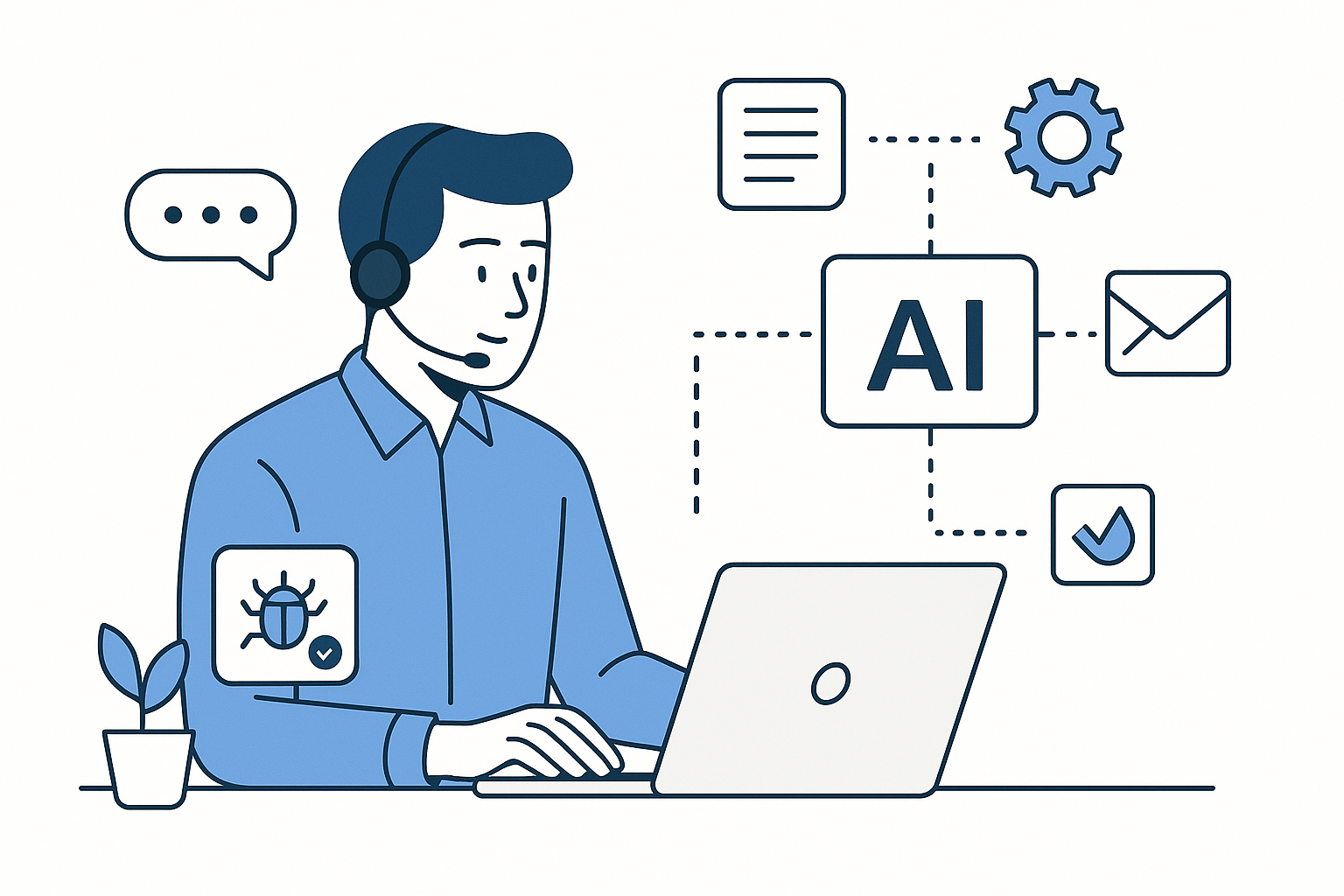
In practical terms, the AI co-pilot assists the advisor in real time while they are processing a ticket. It reads the conversation, analyzes the context, consults the available order or customer history data, and then generates a draft response that the advisor can validate, adjust, and send in a matter of seconds.
How it changes everyday life:
The advisor no longer starts with a blank page. They receive a proposal that is already structured and contextualized with the right information. They retain complete control over what is sent, but save considerable time on each ticket.
At Klark, Copilot works exactly on this principle. AI prepares. Humans validate. The customer receives a quick and accurate response.
The two approaches are complementary, not competitive:
It is this hybrid model that enables the best customer service teams to achieve exceptional results. Studies confirm that mixed human + AI teams are 60% more productive than teams that are 100% human or 100% automated.
No more generic responses that force customers to call back. Agentic AI accesses real data and provides the right answer the first time around. First Contact Resolution, a key customer service indicator, improves automatically.
Result: fewer duplicate tickets, fewer unnecessary escalations, more satisfied customers.
"Where is my order?" doesn't wait for business hours. Agent AI handles these requests at any time, any day, without compromising quality.
Result: immediate response rate on recurring tickets, even at night and on weekends.
Agentic AI enables agents to save an average of 4 hours per week on routine cases. These hours are then devoted to complex situations, dissatisfied customers, and cases that require empathy and human judgment.
Result: teams less exhausted by repetitive tasks, more engaged in value-added interactions.
Agentic AI does not deal with "a customer who has a delivery problem." It deals with "Marie Dupont, a customer for three years, order placed yesterday, package currently stuck at Roissy." This level of detail was previously reserved for the most experienced advisors. It is now becoming accessible on a large scale.
Result: personalized customer experience at no additional cost.
The strength of a well-designed agentic AI is that it fits into your existing stack without reinventing everything. It connects to your Zendesk, Salesforce, Freshdesk, and your carriers' tracking systems. No migration, no disruption.
Result: deployment in a matter of hours, immediate ROI.
Every interaction handled by the agentic AI is a piece of data. You know what types of questions come up most often, at what times, and with which products. This operational intelligence is invaluable for improving your service and training your teams.
The result: complete visibility of your after-sales service, which would be impossible to achieve with advisors alone.
Situation: A customer contacts an e-merchant's customer service department to find out where their order is. This is the most common ticket, sometimes accounting for up to 40% of the volume during peak periods.
Solution: The agentic AI identifies the question, retrieves the order number from the conversation (or asks the customer for it), simultaneously queries the internal order system and the carrier's website, and responds with the exact status: package location, estimated delivery time, clickable tracking number.
Result: Ticket processed in seconds. Zero human intervention. Customer informed accurately.
Situation: A customer wants to return an item after the deadline. The situation is not standard and requires a human decision.
Solution: The Klark Copilot analyzes the conversation in real time, consults the customer's history and return conditions, and generates a personalized draft response that the advisor can validate in seconds. The advisor remains in control, but starts from a foundation that has already been laid.
Result: Processing time cut in half. Response consistent with commercial policy. Customer handled quickly despite complexity.
Situation: A customer is angry. His order has been lost, and it is a gift for his daughter's birthday the next day.
Solution: The agentic AI detects the emotional context and complexity of the situation. It transfers the call to an advisor with a complete summary: customer context, order history, tracking data, reason for escalation. The Copilot then takes over to help the advisor formulate the best possible response.
Result: The advisor immediately gets back to the heart of the matter, without making the customer repeat themselves. Human empathy comes into play where it is truly needed.
"AI will replace my advisors."
No. Agentic AI takes on repetitive, low-value-added tasks that exhaust your advisors without adding value. Complex, emotional interactions that require true human judgment remain human. Real-time AI assistance tools reduce resolution time by up to 30% according to AWS, and organizations deploying AI see an average 25% reduction in their operating costs. The challenge is not to replace humans, but to focus them where they are irreplaceable.
"Customers don't want to talk to AI."
Customers want quick and accurate answers. They don't care about the channel if they get the result they want. What they reject are chatbots that don't understand anything and go round in circles. An agentic AI that answers the first question correctly is perceived positively. 88% of consumers believe that customer experience is as important as the product itself (Salesforce).
"It's too complex to set up".
Next-generation agentic AI solutions are designed to integrate with your existing tools in a matter of hours. At Klark, our customers go from zero to operational without changing their tools, without complex configuration, and without a dedicated technical team. Plug-and-play deployment is now the norm, not the exception.
"We don't have the necessary data."
Agentic AI adapts to the data you have. It can start with your existing order database and gradually enrich itself with other sources (carriers, CRM, ERP). You don't need a perfect infrastructure to get started.
Not all solutions are created equal. Here are the criteria that really make a difference in the field.
Native integration capability: Does the solution connect to your current tools (Zendesk, Salesforce, Freshdesk, Gorgias) without custom development? Good agentic AI should fit into your stack, not force you to rebuild it.
Real-time data access: Can it query your ordering system, carriers, and CRM in real time? AI that responds to static data is not truly agentic.
The combination of autonomy and assistance: Does it offer both an autonomous mode (for repetitive tickets) and a co-pilot mode (to assist your advisors with complex cases)? The best solutions cover both needs.
Autonomous decision-making: Can it decide on its own when it needs additional information? And can it recognize when humans need to take control?
Safeguards and security: Does the solution have mechanisms in place to prevent incorrect responses? Are calls to external systems secure? Is customer data protected?
Transparency regarding actions: Do you know exactly what the AI did to generate each response? Traceability is essential for controlling quality and identifying areas for improvement.
Deployment speed: How long between the decision and the first tickets being processed? A good solution should be up and running in hours, not months.
The next generation of agentic AI will no longer be merely reactive. It will analyze warning signs in advance: a package that has been stuck for 48 hours, a likely delivery delay, a spike in tickets for a specific product. It will contact the customer before they have to contact support. Proactive customer service will become the norm.
The tools available for agentic AI will multiply. Package tracking, carrier data, billing systems, multichannel customer history, logistics platforms: AI will be able to consult a growing number of sources for increasingly accurate and personalized responses.
The future of customer service is neither 100% automated nor 100% human. It is a hybrid model where AI handles repetitive tasks with excellence, and humans intervene in complex cases with information prepared by AI. Advisors become experts in the exceptional, focusing on areas where humans are irreplaceable. 84% of companies using AI in their customer service plan to invest even more in it, a sign that the ROI is perceived as positive.
Klark has built its approach around a simple principle: AI that acts, not just responds. And AI that puts the advisor back in control when it makes sense.
The Copilot: the heart of the reactor
Copilot Klark is the central engine. It reads every conversation in real time, consults your live business data, and generates an accurate, contextualized draft response.
The AI decides for itself which data to retrieve in order to respond correctly. It can query your ERP system to access order, contract, or customer account information. It can also consult carriers via Parcel Tracker (USPS, FedEx, UPS, etc.) to obtain real-time delivery status. Internally measured results show that integrating this external data improves response accuracy by at least 20%.
Automation: when Copilot goes further
For the simplest and most repetitive tickets, Copilot can send the response directly, without the agent having to validate it. This is called automation. It does not replace Copilot: it is a subset of it, activated in cases where the suggestion is reliable enough to be sent automatically.
Agentic AI accelerates both of these through a double effect. It increases the volume of tickets that Copilot can handle. And it improves the quality of suggestions, making more of them eligible for automatic dispatch. The more accurate Copilot is, the more relevant the automation becomes.
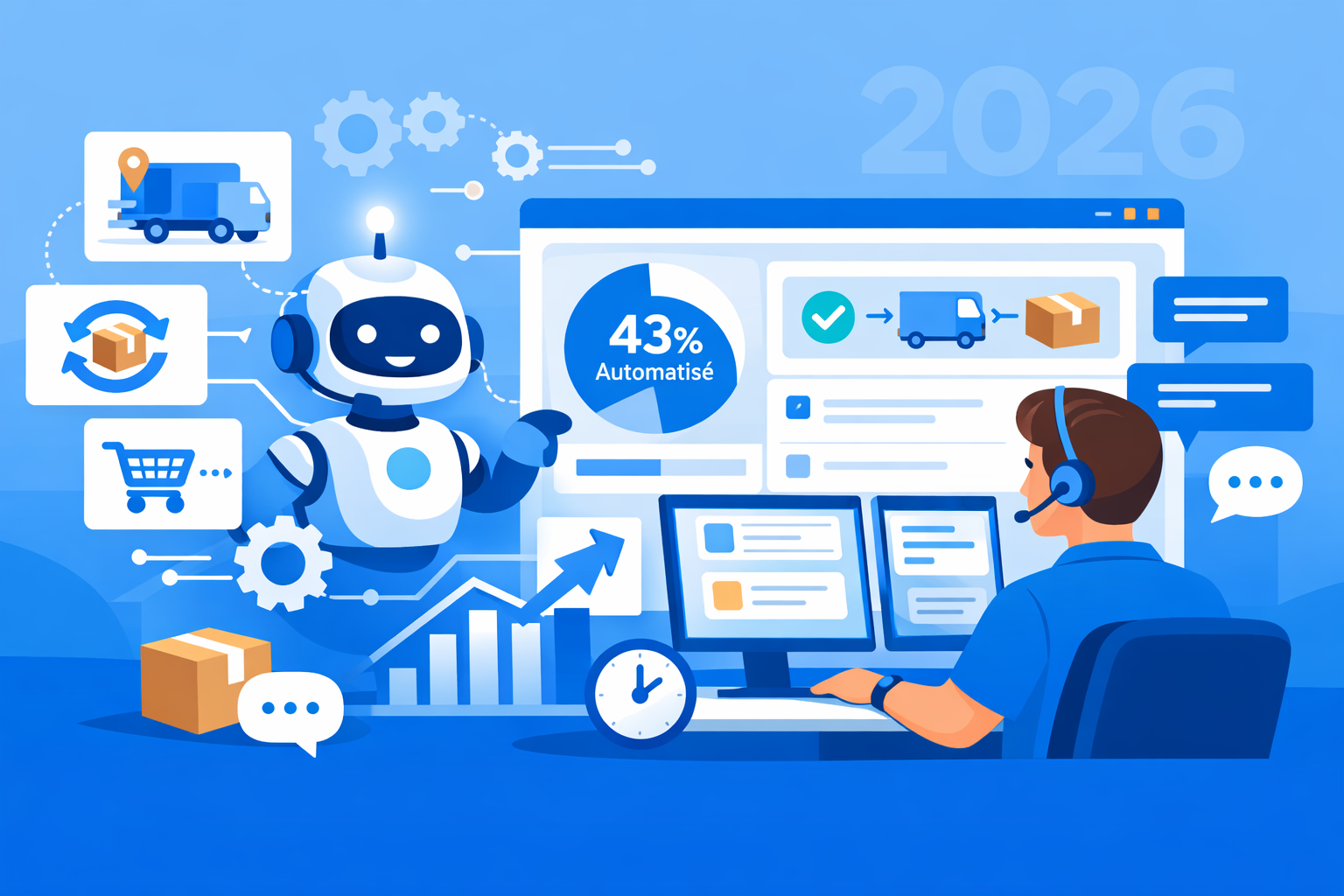
This model enables our customers to achieve a 50% increase in productivity and a 43% increase in automated tickets.
Klark is already used by more than 60 brands and 2,000 agents. Deployable in a matter of hours on Zendesk, Salesforce, Freshdesk, Gorgias, and Front. No complex configuration required.
The real question is no longer "Will agentic AI transform customer service?" It is already doing so.
The question is: which side do you want to be on when your competitors have pulled ahead? 🚀
Klark is a generative AI platform that helps customer service agents respond faster and more accurately, without changing their tools or habits. Deployable in minutes, Klark is already used by more than 60 brands and 2,000 agents.