AI agents as employees: methods, examples and best practices

François
Published on
December 26, 2025

Imagine having tireless employees who never sleep, never complain, and get better every day. 🤖

Welcome to the era of AI agents as employees, a transformation where autonomous AI systems are no longer mere tools, but real members of your team.

In this comprehensive guide, we explore what it means to treat AI agents as employees, methods that work, real-life examples from leading companies, and best practices for successfully integrating AI agents into your team. Let's go! 🚀

What does "AI agents as employees" mean?

AI agents as employees refer to autonomous AI systems that perform tasks traditionally carried out by humans, with a level of independence and decision-making capability that goes far beyond simple automation.

Key features :

  • Autonomous: can make decisions without constant human supervision
  • Task-oriented: with specific roles and responsibilities (like employees)
  • Continuous learning: improve performance over time
  • Collaborative: working alongside human employees
  • Responsible: their performance can be measured and optimized

The difference with conventional automation:

Classic automationAI agents as employees
Follows fixed rulesMakes contextual decisions
Repetitive tasks onlyHandles complexity and ambiguity
No trainingContinuous improvement
Passive toolActive contributor
Replaces tasksEnhances human capabilities

Why AI agents as employees in 2025?

The figures speak for themselves:

  • 78% of SMEs will adopt AI by the end of 2025 (Capgemini, 2024)
  • 20-30% productivity gains by 2030 (McKinsey)
  • 24/7 availability without increasing human resources
  • 70% of working hours could be automated (McKinsey)
  • Average ROI of 3x on AI agent investments

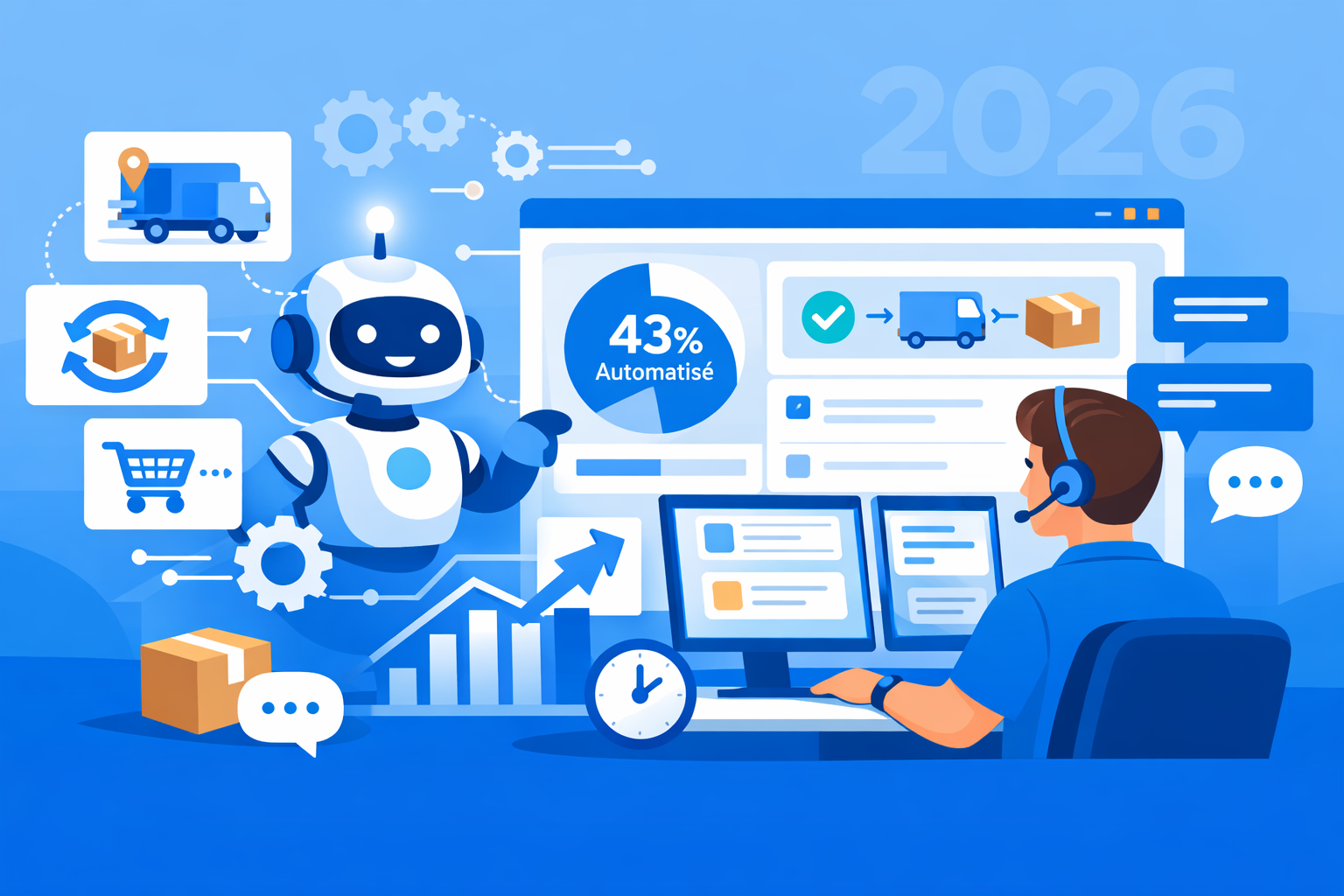
At Klark, we see our customers seeing their customer service teams augmented by AI get +50% productivity and 43% automation.

The key roles of AI agents in the enterprise

1. IA customer service agent

Role: First point of contact for customers, resolves requests automatically, escalates complex cases.

Typical tasks :

  • Answering frequently asked questions 24/7
  • Monitor order status
  • Managing password resets
  • Qualify and route tickets
  • Collect customer information

Performance: Can handle 40-60% of total ticket volume without human intervention.

Find out how an AI agent works in detail.

2. IA sales agent (virtual SDR)

Role: Qualify leads, engage prospects, schedule appointments.

Typical tasks :

  • Prospecting and personalized outreach
  • Lead qualification (automatic scoring)
  • Automatic multi-channel follow-ups
  • Meeting planning
  • Real-time CRM updates

Impact: Allows human sales reps to focus on closing, not prospecting.

3. IA back-office agent

Role: Handle repetitive administrative tasks (billing, data entry, reports).

Typical tasks :

  • Data extraction and entry
  • Automatic report generation
  • Invoice and payment processing
  • Document management
  • Compliance checks

4. AI HR agent (recruitment and onboarding)

Role: CV sorting, first interview, onboarding of new employees.

Typical tasks :

  • Screening applications
  • Pre-qualification interviews
  • Scheduling interviews
  • Automated onboarding (documents, training)
  • Answers to common HR questions

5. AI coding assistants

Role: Help with code writing, debugging, documentation.

Typical tasks :

  • Basic code generation
  • Bug detection
  • Writing unit tests
  • Automatic documentation
  • Code review

How to integrate AI agents as employees (complete method)

Step 1: Identify the roles to be expanded

Don't look for ways to replace humans. Instead, identify where AI can :

  • Absorb repetitive tasks
  • Handling large volumes
  • Provide 24/7 availability
  • Speed up slow processes

Questions to ask :

  • Which tasks take up 80% of your time but generate 20% of the value?
  • Where do we have bottlenecks?
  • Which tasks are predictable and rule-based?

Step 2: Define the AI agent's "position

Treat the AI agent as a real recruit:

  • Job title: e.g. "Agent IA Service Client", "SDR IA".
  • Mission: main objective
  • Responsibilities: specific tasks
  • KPIs: performance measures
  • Limits: what the agent must NOT do

Example of a job description for an IA agent :

Position: IA Customer Service Agent

Mission: Resolve 50% of customer requests automatically in less than 2 minutes

Responsibilities :

  • Answer questions about orders, deliveries and products
  • Traiter les demandes de remboursement < 50€
  • Escalate complex cases to humans with full context

KPIs :

  • Automatic resolution rate > 50%.
  • CSAT > 85
  • Temps de réponse < 30 secondes

Step 3: Train the AI agent

Like a human employee, the AI agent needs training:

  • Knowledge base: document your processes, products and policies
  • Historical data: use past conversations for training
  • Tone of voice: define your communication tone (formal, casual, etc.).
  • Borderline cases: teach how to handle atypical situations

At Klark, this training is done automatically: we analyze your existing conversations and build the knowledge base in just a few hours.

Step 4: Gradual deployment

Do not deploy 100% immediately:

  1. Pilot phase (10% of traffic): test on a small segment for 2-4 weeks
  2. Analysis and adjustments: correct errors, improve answers
  3. Progressive scale (30% → 50% → 80%): gradually increase the load
  4. Continuous monitoring: monitor KPIs on a daily basis

Step 5: Manage the AI agent as an employee

Yes, AI agents need management!

  • Weekly performance reviews: analyze KPIs
  • Coaching: identify weaknesses, enrich the knowledge base
  • Feedback loop: collect feedback from customers and human employees
  • Role evolution: gradually expand responsibilities

Concrete examples of companies using AI agents as employees

Example 1: Klarna (1 AI agent = 700 employees)

Swedish fintech Klarna has deployed an AI agent that :

  • Manages the equivalent of 700 human agents
  • Handles 2/3 of customer conversations
  • Reduces resolution time from 11 minutes to 2 minutes
  • Available in 35 languages

Result: $40M in annual savings, increased customer satisfaction.

Example 2: Octopus Energy (33% of support managed by AI)

The British energy supplier uses an AI agent that :

  • Responds to 33% of customer emails
  • Achieves 80% CSAT (equivalent to humans)
  • Frees up human agents for complex cases

Example 3: Click&Boat with Klark

The boat rental platform has been using Klark for 10 months:

  • 43% of tickets managed automatically
  • +50% increase in human agent productivity
  • Happier team (fewer repetitive tasks)

Best practices for success

1. Set clear limits

Your AI agent must know when to hand over to a human:

  • Complex cases after 2-3 exchanges
  • Sensitive requests (legal, safety)
  • VIP or emotionally-charged customers
  • High amounts (reimbursements > defined threshold)

2. Total transparency

Be honest with your customers:

  • Clearly indicate when they are talking to an AI agent
  • Always offer the option of human contact
  • Explain how data is used

3. Human-IA collaboration

The best results come from collaboration, not replacement:

  • AI handles volume and repetitive tasks
  • Humans manage complexity and empathy
  • Fluid context switching between AI and human

4. Further training

The AI agent must evolve:

  • Regular enrichment of the knowledge base
  • Analysis of failed conversations
  • A/B testing new approaches
  • Adapting to new products/processes

5. Measure rigorously

Key KPIs :

  • Automation rate: % of tasks solved without human intervention
  • CSAT: agent-specific satisfaction IA
  • Average resolution time
  • Escalation rate: % of conversations transferred
  • ROI: savings vs. cost of AI

To find out more about performance measurement, read our guide to measuring customer satisfaction.

Challenges and how to overcome them

Challenge #1: Employee resistance

Solution: Transparent communication

  • Explain that AI augments, not replaces
  • Show how AI frees up time for value-added tasks
  • Involve teams in deployment
  • Share productivity gains

Challenge #2: AI Hallucinations

Solution: Use RAG (Retrieval-Augmented Generation)

  • AI first retrieves information from your database
  • Then generates a response based on this verified data
  • Drastically reduces errors

Find out how RAG works for customer support.

Challenge #3: Lack of training data

Solution: Start with what you have

  • Use your existing customer conversations
  • Progressively document your processes
  • AI learns from each new interaction

Challenge #4: Too high a perceived cost

Reality: ROI is massive

  • Typical payback: 2-4 months
  • 30-40% reduction in operating costs
  • 50-70% increase in productivity

At Klark, we charge by success. You only pay when it works.

The future: agentic AI agents

The future of AI agents? Agentic AI agents:

  • Take action (not just answers)
  • Orchestrate multi-step workflows
  • Collaborate between agents (an AI sales agent talks to an AI back-office agent)
  • Anticipate needs even before the customer asks for them

To understand this revolution, read our article on agentic AI.

Ready to recruit your first AI agents?

AI agents as employees are no longer science fiction. It's the reality of 2025.

Key points to remember :

  • Treat AI agents like real employees (roles, KPIs, management)
  • Don't look to replace, but to expand your human teams
  • Deploy gradually, measure rigorously, optimize continuously
  • The best results come from human-IA collaboration
  • Typical ROI: 3x in the first year

Want to see what an AI agent can do for your team? Request a Klark demo and see how we deploy high-performance AI agents in hours, not months.

Because your competitors are already recruiting their AI agents. Don't let them get too far ahead. 🚀

About Klark

Klark is a generative AI platform that helps customer service agents respond faster and more accurately, without changing their tools or habits. Deployable in minutes, Klark is already used by over 50 brands and 2,000 agents.

You might like

Klark blog thumbnail
- 5 MIN READING 

RAG for customer support: methods, examples and best practices

Discover how RAG (Retrieval-Augmented Generation) is transforming customer support: methods, real-life examples, best practices for delivering accurate, up-to-date answers while eliminating AI hallucinations.
Klark's author
Chief of Staff
Klark blog thumbnail
- 5 MIN READING 

What is an AI agent? Definition, role and the customer support revolution

Find out what an AI agent is: a clear definition, how it works, how it differs from chatbots, and how these autonomous artificial intelligences will revolutionize customer service in 2025.
Klark's author
Co-founder and Co-CEO
Klark blog thumbnail
- 5 MIN READING 

Generative AI customer service: methods, examples and best practices

Discover how generative AI (GenAI) is transforming customer service: methods, real-life examples, best practices, and how to deploy it successfully to boost productivity, cut costs and improve customer satisfaction.
Klark's author
Co-founder and Co-CEO
Klark blog thumbnail
- 5 MIN READING 

AI agents as employees: methods, examples and best practices

Find out how to integrate AI agents as employees: proven methods, real-life examples from leading companies (Klarna, Octopus Energy), and best practices for augmenting your teams with AI in 2025.
Klark's author
Chief of Staff
Klark blog thumbnail
- 5 MIN READING 

Artificial intelligence in customer relations: methods, examples and best practices

Discover how artificial intelligence is transforming customer relations: proven methods, concrete examples of successful companies, and best practices for successfully deploying AI in your customer service department.
Klark's author
Chief of Staff
Klark blog thumbnail
- 5 MIN READING 

Agentic AI: a new era for AI... but not without humans

AI is entering a new phase: that of agents capable of acting on their own... Find out what this means for support teams, and Klark's vision of it.
Klark's author
Chief of Staff