Agentic AI for e-commerce customer service: revolutionizing the customer experience in 2026

François
Published on
January 9, 2026

Do you manage customer service for an e-commerce site and find yourself overwhelmed with questions like "Where is my order?", "How do I return an item?" or "The promo code isn't working"? 🤔

Your teams spend 70% of their time on repetitive questions. Peak periods (Black Friday, sales) turn into a nightmare. And meanwhile, complex requests that really need human attention pile up.
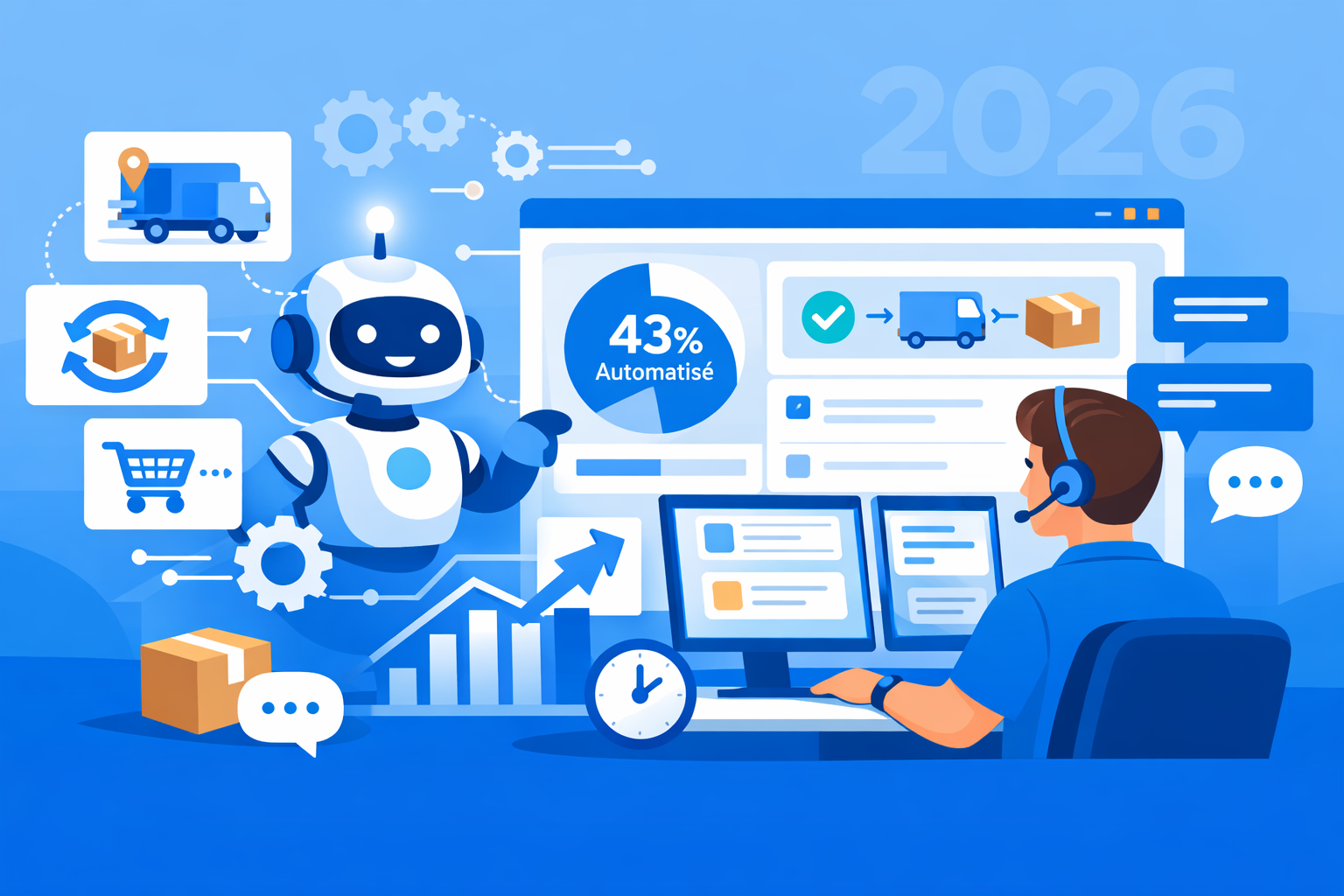
Spoiler alert: agentic AI will not replace your agents. It will transform them into customer service superheroes.

In this guide, we explain:

  • What agentic AI really is (and why it's changing everything for e-commerce)
  • How it works in practice in an e-commerce context
  • The 7 measurable benefits for your teams
  • Specific e-commerce use cases with results
  • How Klark helps e-merchants automate 43% of their tickets

Let's go! 🚀

What is agentic AI for e-commerce customer service?

Agentic AI is artificial intelligence capable of acting autonomously to perform complex tasks, not just answering questions.

In plain English?

Unlike a traditional chatbot that simply responds with "Your order is being delivered," an agentic AI will:

  • Automatically check the order status
  • Check carrier tracking
  • Identify any potential delays
  • Propose corrective action (reshipment, refund)
  • All this in a matter of seconds, without human intervention.

The key difference: Agentic AI doesn't just talk. It acts.

In e-commerce specifically, this means that it can:

  • Access your systems (ERP, CRM, helpdesk)
  • Process requests from start to finish
  • Make decisions based on your business rules
  • Learning from every interaction

It's like having an assistant who understands the context AND can take action.

Agentic AI vs. traditional chatbots: what's the difference in e-commerce?

Criteria Classic chatbot Agentic AI
Comprehension Fixed keywords Natural language + context
Actions None Access systems, execute
Autonomy Predefined scripts Contextual decisions
E-commerce "Contact support" Resolves 43% of tickets
Deployment 8-16 weeks 2-4 hours

Case in point:

Classic chatbot:Customer: "I want to return my order." Bot: "For returns, click here: [FAQ link]" → The customer has to figure it out on their own.

Agent AI:Customer :"I want to return my order." AI: "I see that you ordered [product] on [date]. I am generating your return slip. You will receive it by email in 2 minutes. The refund will be processed within 5 business days." → Problem solved. Time saved: 8 minutes.

Can you see the difference?

Why agentic AI is crucial for e-commerce in 2026

The figures speak for themselves:

  • 67% of e-commerce customers abandon their shopping cart if customer support is not responsive.
  • 82% of buyers want a response within 10 minutes.
  • 43% of e-commerce tickets can be automated (order tracking, returns, changes)
  • +150% volume during peak periods (Black Friday, sales)
  • 3x higher turnover in e-commerce support teams compared to other sectors

The problem with e-commerce? Volume trumps everything.

A site that receives 10,000 orders per month easily generates 2,000 to 3,000 tickets. During sales? Multiply that by three.

Your human agents can't keep up. Result:

  • Response times skyrocketing 📈
  • Customer satisfaction in free fall 📉
  • Teams experiencing burnout
  • Soaring costs 💰

Agentic AI is the only scalable solution for managing this volume without blowing your budget or overwhelming your teams.

How does agentic AI work in e-commerce? (step by step)

Let's break down the process to understand the magic behind it.

Step 1: Receipt and analysis of the request

A customer sends a message: "Hello, I still haven't received my order #45678, which I placed 5 days ago."

Agentic AI analyzes:

  • The intention: order tracking
  • Context: order number provided
  • The urgency: 5-day deadline mentioned
  • The tone: moderate concern

Step 2: Connecting to the systems

AI automatically connects to:

  • Your e-commerce platform (Shopify, WooCommerce, Magento)
  • Your order management system
  • Carrier tracking (Chronopost, Colissimo, UPS)
  • Your helpdesk (Zendesk, Freshdesk, Intercom)

All that in less than 2 seconds.

Step 3: Data collection and analysis

AI consults:

  • Actual order status
  • Shipping history
  • Last location of the package
  • Estimated delivery date
  • Possible carrier incidents

Step 4: Contextual decision-making

Based on what it discovers, the AI decides:

  • Scenario A: Package in normal transit → Reassure the customer with accurate tracking
  • Scenario B: Delay identified → Offer compensation (gift card, free shipping)
  • Scenario C: Lost package → Initiate automatic reshipment

Step 5: Action and response

AI generates a personalized response and executes the necessary actions:

  • Send detailed tracking information to the customer
  • Create a voucher if necessary
  • Updates the ticket in the helpdesk
  • Notify the team if escalation is necessary

Step 6: Continuous learning

Every interaction enriches AI:

  • Which keywords indicate a high level of urgency?
  • What types of compensation satisfy customers the most?
  • What patterns indicate a complex problem?

The result? AI that becomes increasingly powerful, specifically for YOUR e-commerce business.

The 7 advantages of agentic AI for e-commerce

1. Instant processing of repetitive requests

70% of e-commerce tickets concern:

  • Order tracking
  • Returns and refunds
  • Address changes
  • Promo codes
  • Product availability

With agentic AI: Response in less than 30 seconds, 24/7, even at 3 a.m.

Results for our e-commerce customers: 43% of tickets resolved automatically.

2. Scalability during peak activity periods

Black Friday, sales, holiday season: ticket volume can triple in a matter of hours.

Before AI: You hire temporary workers, you pay overtime, you pray.

With agentic AI: It absorbs the peak without flinching. Your agents focus on complex cases.

Impact: At But, 60% of resolutions during Black Friday with the same team.

3. Drastic reduction in processing time

Average time per e-commerce ticket:

  • Classic chatbot: 8-12 minutes (with agent escalation)
  • Human agent alone: 5-7 minutes
  • Agentic AI: 30 seconds to 2 minutes

Result: +50% increase in agent productivity at CDiscount.

4. Enhanced customer experience

E-commerce customers want:

  • Rapidité (82% attendent une réponse en <10 min)
  • 24/7 availability (67% contact support outside of business hours)
  • Immediate resolution (74% abandon if there is no quick solution)

Agentic AI ticks all the boxes.

5. Reduction in operating costs

A human agent costs on average €2,500 to €3,500 per month (salary + expenses).

An agentic AI that handles 43% of tickets = savings of 1 to 2 agents in a team of 5.

Positive ROI within 3-4 months for most of our clients.

6. Freeing up time for high-value tasks

Your agents no longer spend 70% of their time on "Where is my order?".

They can focus on:

  • Complex cases (disputes, product issues)
  • Premium customer relations
  • Customer loyalty (upselling, cross-selling)
  • Process improvement

Impact: Improved employee satisfaction, 30% reduction in turnover.

7. Actionable data and insights

Agentic AI collects and analyzes:

  • Which products generate the most tickets?
  • What problems come up repeatedly?
  • What causes customer friction?

Example at Back Market: AI identified that 15% of tickets concerned a problem with the instructions. Corrected within 48 hours. 15% fewer tickets the following month.

The different types of agentic AI for e-commerce

1. Agent AI for customer support

Usage: Ticket management, FAQ, order tracking, returns.

Tools: Klark Copilot (agent assistant) + Klark Chat (standalone).

Ideal for: E-merchants with a high volume of repetitive tickets.

Example: CDiscount uses Klark to automatically process tracking and return requests.

2. Agentic AI for product recommendations

Usage: Personalized suggestions based on purchasing behavior.

How it works: Historical analysis + preferences + context.

Ideal for: Websites with a large catalog (>1000 products).

Limitation: Does not replace the advice of a technical product agent.

3. Agentic AI for returns management

Usage: Complete automation of the return/refund process.

Possible actions:

  • Return slip generation
  • Compliance validation
  • Triggering reimbursement
  • Trade management

Ideal for: Fashion, electronics (high return rate).

4. Agent-based AI for fraud prevention

Usage: Detection of suspicious behavior, identity validation.

Operation: Pattern analysis, weak signals, history.

Ideal for: Sites with high average basket values or resalable products.

Limitation: Requires human validation for final decisions.

5. Multichannel agentic AI

Usage: Centralized support (email, chat, social media, phone).

Advantage: Unified customer view, consistent responses.

Ideal for: E-merchants operating across multiple channels.

Example: With Klark, your agents have all the information they need, regardless of the channel.

Concrete use cases for agentic AI in e-commerce

Use case 1: Automated order tracking

Customer: "Hello, what is the status of my order #12345?"

Agentic AI:

  1. Check the management system
  2. Check carrier status
  3. Identifies: package in transit, delivery scheduled for tomorrow between 2:00 p.m. and 6:00 p.m.
  4. Generates response: "Your order is currently being delivered. It will arrive tomorrow between 2 p.m. and 6 p.m. Here is the tracking link: [URL]. Have a nice day!"

Result: Ticket resolved in 30 seconds. Customer satisfied. Agent saved.

Use case 2: Express returns management

Customer: "I want to return the shoes, they're too small."

Agentic AI:

  1. Identify the order (shoes purchased 10 days ago)
  2. Check return eligibility (within 30 days, conditions OK)
  3. Generate return slip + prepaid label
  4. Send by email
  5. Offering exchange: "Would you like the next size up? I can reserve it for you."

Result: Problem solved + sales opportunity retained.

Use case 3: Proactive management of delivery delays

Scenario: AI detects that a package is three days late.

Agentic AI:

  1. Proactively contact the customer
  2. Apologizes for being late
  3. Offers compensation (€10 gift card)
  4. Provides accurate tracking
  5. Offers the option of reshipment if lost

Result: Customer reassured BEFORE complaining. Satisfaction maintained.

Use case 4: Automatic multilingual support

Customer (in German): "I haven't received my order yet."

Agentic AI:

  1. Detects language
  2. Process the request in German
  3. Access the systems (same process as in French)
  4. Responds in German with accurate information

Result: International support without hiring German-speaking agents.

Use case 5: Managing Black Friday peaks

Scenario: Black Friday, 3,000 tickets in 24 hours (vs. 500 usually).

Agentic AI:

  • Processes 1,300 tickets automatically (tracking, returns, promo codes)
  • Prioritize the remaining 1,700 by urgency
  • Human agents focus on disputes and after-sales service

Result: Average response time: 15 minutes (vs. 4 hours without AI).

Fears surrounding agentic AI in e-commerce (and why they are unfounded)

"AI will replace my agents"

False.

Agentic AI handles repetitive tasks. Your agents move from "Where is my order?" to strategic missions:

  • Resolution of complex disputes
  • Premium customer relations
  • Process improvement

At Klark, our clients have retained 100% of their workforce. They have simply reassigned them to higher-value tasks.

"It's too complex to implement."

Not anymore.

Previous solutions required 3-6 months of configuration. With platforms such as Klark:

  • Deployment in 2-4 hours
  • Zero process mapping
  • Plug-and-play on your existing helpdesk (Zendesk, Freshdesk, Gorgias)

"My customers will hate talking to an AI."

On the contrary.

74% of e-commerce customers prefer an instant response from AI to waiting two hours for a human agent.

What they want:

  • Speed ✅
  • Effective resolution ✅
  • Available 24/7 ✅

Agentic AI ticks all the boxes.

"AI does not understand complex cases."

It is precisely his role to identify them.

A well-configured agentic AI can recognize:

  • A very dissatisfied customer (immediate escalation)
  • A complex dispute (agent transfer)
  • An out-of-scope request (human redirection)

At But, AI detects sensitive cases and transfers them in less than 30 seconds.

"It's too expensive for my e-commerce business."

The cost of inaction is higher.

Simple calculation:

  • 1 agent = $2,500/month
  • AI automating 40% = savings of $1,000/month on a team of 3
  • Positive ROI from the third month onwards

Not to mention:

  • Reduction in turnover (costly recruitment)
  • Improved customer satisfaction (better retention)
  • Growth without cost explosion

How to choose your agentic AI for e-commerce?

Not all tools are created equal. Here are the essential criteria:

1. Compatibility with your e-commerce stack

YourAI must connect natively to:

  • Your platform (Shopify, WooCommerce, Magento, PrestaShop)
  • Your helpdesk (Zendesk, Freshdesk, Gorgias, Intercom)
  • Your carriers (FedEx, UPS, DHL)
  • Your ERP/CRM

2. Speed of deployment

Ifsomeone tells you it will take three months to configure, run away. In 2026, effective deployment takes 2-4 hours.

3. Real capacity for action

Ensurethat the AI can:

  • Consult your databases
  • Perform actions (create return slip, modify order)
  • Not just "responding nicely"

4. Scalability

YourAI must be able to handle spikes in activity without breaking a sweat. Ask for proof (Black Friday, sales).

5. Customization

AImust learn from YOUR data, not generic data. Every e-commerce business has its own specific characteristics.

6. Agent-friendly interface

Ifyour agents dislike the tool, it will not be used. The interface must be intuitive and integrate into their existing workflow.

7. Support and guidance

Choosea partner who will support you over the long term, not just a self-service tool.

8. Proven results in e-commerce

Ask fore-commerce case studies with figures. If the supplier sidesteps the question, that's a bad sign.

Spoiler alert: Klark ticks all these boxes. And we can prove it. 😉

The future of agentic AI in e-commerce: what lies ahead

1. Predictive and proactive AI

Tomorrow, AI will no longer be content to react. It will anticipate.

Examples:

  • Detection of a defective product in a batch → Proactive contact with affected customers
  • Behavior analysis → "This customer is at risk of unsubscribing" → Preventive action
  • Peak demand forecast → Automatic resource reinforcement

2. Hyper-advanced customization

AI will combine:

  • Purchase history
  • Browsing behavior
  • Past interactions
  • Customer sentiment

Result: Each interaction will be unique, as if the agent had known the customer for 10 years.

3. Advanced voice integration

Agentic AI will no longer be limited to text. It will manage:

  • Incoming phone calls
  • Instant voice support
  • Real-time emotional analysis

4. End-to-end automation

From ordering to after-sales service, the entire customer cycle will be orchestrated by AI:

  • Custom order confirmation
  • Proactive delivery tracking
  • Automatic feedback request
  • Frictionless returns management
  • Loyalty relaunch

5. Collaborative multi-agent AI

Several specialized AIs will work together:

  • AI 1: Customer support
  • AI 2: Product recommendation
  • AI 3: Logistics Management
  • AI 4: Personalized marketing

Everything coordinated for a seamless customer experience.

At Klark, we are already building this vision. E-merchants who adopt agentic AI now will dominate their market tomorrow.

Why choose Klark for your e-commerce agentic AI?

Because we have built a solution designed for the real constraints of e-commerce.

1. Express deployment

2-4hours from connection to the first automatic resolution. Not 3 months.

2. Plug-and-play with your stack

Workswith Zendesk, Gorgias, Freshdesk, Intercom. Integrates with Shopify, WooCommerce, Magento.

3. Designed for peak activity

Oure-commerce clients (But, CDiscount, Back Market) absorb Black Friday without hiring.

4. Proven results in e-commerce

  • 43% automated tickets on average
  • +50% agent productivity
  • 60%+ resolutions during peak times
  • Positive ROI in 3-4 months

5. No complex mapping

AIlearns from your existing data. Zero manual workflow configuration.

6. Augmented agents, not replaced

KlarkCopilot assists your agents in real time. They remain in control, while AI saves them time.

7. Dedicated e-commerce support

Weunderstand your challenges: volume, seasonality, multichannel. We're here to help.

8. Over 50 brands trust us

Includinge-commerce leaders who manage millions of transactions.

To discover exactly how Klark can transform your e-commerce customer service, check out our guide to AI copilots for support agents.

Conclusion: Agentic AI, the competitive advantage for e-retailers in 2026

Summary of key points:

  • ✅ Agentic AI doesn't respond, it acts
  • ✅ 43% of e-commerce tickets can be automated
  • ✅ Perfect scalability to absorb peaks (Black Friday, sales)
  • ✅ +50% agent productivity + maintained satisfaction
  • ✅ Positive ROI in 3-4 months
  • ✅ Deployment in hours, not months
  • ✅ Your agents remain at the heart of the business, with AI freeing them from repetitive tasks

The reality of e-commerce in 2026: Your competitors are already adopting agentic AI. Customers expect a response in less than 10 minutes, 24/7. Without agentic AI, you lose your competitive edge.

But make no mistake: agentic AI does not replace humans. It restores their value. Your agents no longer spend 70% of their time on "Where is my order?" They focus on interactions that truly create value: complex disputes, premium customers, loyalty.

Want to see how Klark is transforming e-commerce customer service? Discover Klark and let's discuss your specific case.

Because ultimately, the best e-commerce customer service is one that responds instantly to simple requests AND devotes time to situations that require empathy and human expertise. 🚀

About Klark

Klark is a generative AI platform that helps customer service agents respond faster, more accurately, without changing their tools or habits. Deployable in minutes, Klark is already used by over 50 brands and 2,000 agents.

Want to see how Klark is transforming e-commerce customer service?
👉 Book a free demo or contact our team

You might like

Klark blog thumbnail
- 5 MIN READING 

Agentic AI for e-commerce customer service: revolutionizing the customer experience in 2026

Discover how agentic AI is transforming e-commerce customer service: 43% of tickets automated, peaks in activity absorbed, and ROI in 3-4 months. Comprehensive guide with use cases.
Klark's author
Chief of Staff
Klark blog thumbnail
- 5 MIN READING 

AI solutions for customer service: what alternatives are there to traditional CRM systems?

Intercom Fin, Zendesk AI, HubSpot Breeze... Native AI promises to automate support, but often locks teams into a single ecosystem. This article breaks down the limitations of "closed" AI and shows why a CRM-agnostic, co-pilot approach is more effective, flexible, and cost-effective for customer service.
Klark's author
Chief of Staff
Klark blog thumbnail
- 5 MIN READING 

RAG for customer support: methods, examples and best practices

Discover how RAG (Retrieval-Augmented Generation) is transforming customer support: methods, real-life examples, best practices for delivering accurate, up-to-date answers while eliminating AI hallucinations.
Klark's author
Chief of Staff
Klark blog thumbnail
- 5 MIN READING 

What is an AI agent? Definition, role and the customer support revolution

Find out what an AI agent is: a clear definition, how it works, how it differs from chatbots, and how these autonomous artificial intelligences will revolutionize customer service in 2025.
Klark's author
Co-founder and Co-CEO
Klark blog thumbnail
- 5 MIN READING 

Generative AI customer service: methods, examples and best practices

Discover how generative AI (GenAI) is transforming customer service: methods, real-life examples, best practices, and how to deploy it successfully to boost productivity, cut costs and improve customer satisfaction.
Klark's author
Co-founder and Co-CEO
Klark blog thumbnail
- 5 MIN READING 

AI agents as employees: methods, examples and best practices

Find out how to integrate AI agents as employees: proven methods, real-life examples from leading companies (Klarna, Octopus Energy), and best practices for augmenting your teams with AI in 2025.
Klark's author
Chief of Staff