An SLA can quickly end up looking like just another KPI among a sea of other metrics.
In reality, an SLA is designed to answer a very simple question: How long do you promise to take to handle a customer request, and how do you keep that promise?
Without an SLA, a support team often operates on a hunch. Urgent tickets get mixed in with the rest, sometimes handled too quickly, sometimes too slowly, depending on the agents’ judgment. And as soon as the volume increases, delays pile up without a clear framework.
With a solid SLA, support becomes easier to manage. Priorities are clear. Deadlines are well-defined. Deviations are spotted earlier and can be handled on “autopilot” because, once you’re overwhelmed, you won’t have time to think about your prioritization rules.
But you still need to avoid a “false” SLA—the kind that’s just included in a contract or hastily approved by your CEO, but ultimately doesn’t help anyone.
SLA means Service Level Agreement, or service level agreement.
In customer service, an SLA typically defines a response time, a resolution time, the scope of service, and sometimes different commitments based on the priority or criticality of the ticket.
For example: a "standard" ticket must be resolved within 24 business hours, a priority ticket within 4 business hours, and a critical ticket must be handled immediately by an experienced agent.
The definition of a "good" SLA is therefore not merely theoretical: it is an operational commitment and a tool for day-to-day management.
A good SLA doesn't just say, "We'll get it done quickly." It specifies who responds, within what timeframe, for which cases, and according to what prioritization criteria. Ultimately, it's a metric that must align with your vision for customer service and, more broadly, with the experience you want to deliver to your customers.
An SLA primarily serves to align three key elements: customer expectations, internal processes, and actual performance metrics.
Without this alignment, support resources are quickly exhausted. The customer expects a response within an hour. The team aims for "within the day." Managers focus on satisfaction metrics or the backlog, without knowing exactly where delays are occurring.
The SLA brings order to the situation: it is a key metric for managing your department’s performance.
Not all teams are on the same page when it comes to SLAs. That’s often where the confusion starts.
1. The First Response SLA
It measures the time between when a ticket is opened and the first response sent to the customer. It is useful when the main focus is on perceived responsiveness.
2. The Resolution SLA
It measures the time it actually takes to close the request. A team may very well have a good initial response time but a poor resolution time.
3. Service Level Agreements by priority or by segment
Not all tickets are created equal. A robust SLA therefore often breaks down commitments by severity level, channel, or customer segment.
| SLA Type | What it measures | Keep an eye on |
|---|---|---|
| First response | Time between ticket creation and the first helpful response | Do not count a simple automatic acknowledgment as a valid response |
| Resolution | Time until the request is actually resolved | Clearly distinguish between customer wait time, escalation, and actual time spent on the issue |
| Priority / segment | Deadlines vary depending on criticality, channel, or customer category | Avoid applying the same resolution to all tickets |
The SLA level It then becomes a real tool for prioritization, not just a single number slapped onto the entire document for cosmetic purposes.
Many SLAs fail because they are too vague.
A good SLA must, at a minimum, specify the start date of the timeframe, the end date of the timeframe, the hours covered, the applicable priorities, the exceptions, and the scope of coverage.
"Response within 8 hours" isn't enough if no one knows whether Saturdays count, whether an acknowledgment of receipt counts as a response, or whether a ticket pending customer action is excluded from the calculation.
The problem isn't the formula. The problem is the ambiguity.
A SLA agreement The text must be understandable to the relevant parties, not just to the legal team.
Failure to meet SLAs is rarely due to a single factor.
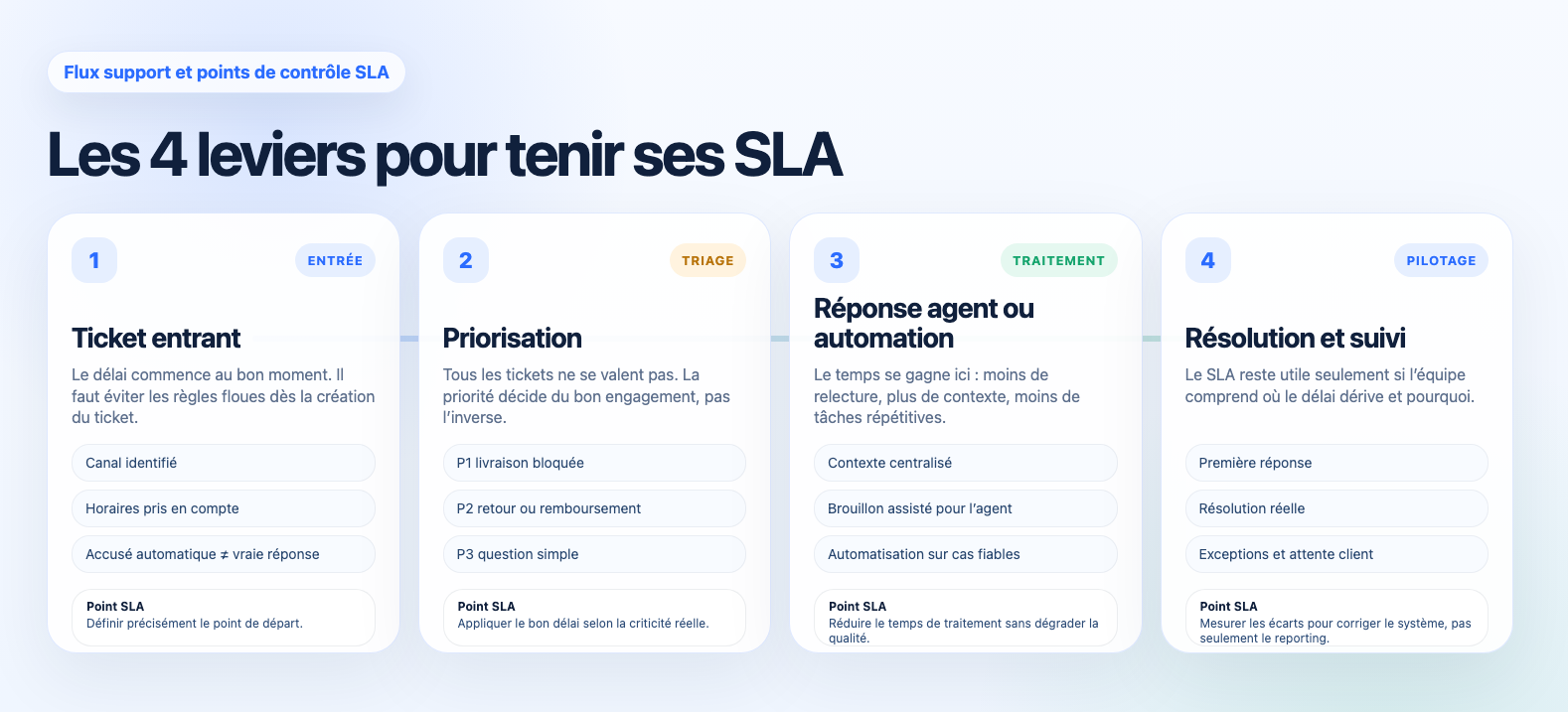
There is also a less obvious problem: some teams measure the delay but do not improve the system or address the causes of the delay.
They see that the SLA processing time getting out of hand. They know the backlog is growing, but agents still have to piece together the context manually, check multiple tools, and repeat the same responses.
In this case, the SLA becomes a symptom and loses its purpose as a management tool.
AI does not replace an SLA. However, it can help ensure that it is better adhered to.
Help set priorities
AI systems enable the categorization and measurement of customer sentiment across all incoming interactions. With this data, customer service teams can then establish simple prioritization rules (for example, a ticket in a certain category is considered a priority, or an annoyed customer triggers a higher priority...).
Reduce time wasted on repetitive tasks
When certain interactions can be reliably automated, the team frees up time to focus on more complex cases. At Klark, part of this approach involves automating recurring requests when the level of reliability is sufficient.
Help agents respond faster
When an agent has to review the ticket history, search for information across multiple tools, and then draft a response from scratch, each ticket takes longer to resolve. A well-integrated assistant can help centralize relevant context and generate a draft more quickly for approval.
Better manage peaks in activity
Solutions like Klark help distribute the workload more effectively between agent support and the automation of certain requests. This can help reduce processing times, provided that the scope is clearly defined.
Many teams believe that a good SLA should be shorter. That's not always true.
A useful SLA is, above all, a credible SLA.
It is often better to have a more realistic SLA that is consistently met than a very aggressive SLA that is constantly missed.
The appropriate level depends on the volume of incoming requests, the type of requests, the available tools, the extent to which processes can be automated, and the level of operational maturity.
If your SLA isn't being met, the first step isn't to change the number on a dashboard. You need to start by looking at the situation on the ground.
Step 1. Group the tickets by actual nature
Simple questions, requests requiring order or CRM context, sensitive cases, escalations: without understanding this, you’ll be applying the same promise to different situations.
Step 2. Clarify the starting point and exceptions
Does the ticket start when it is created? After it is assigned? Does the time limit end upon acknowledgment of receipt or upon the first substantive response? The compliance with SLAs depends first and foremost on that clarity.
Step 3. Identify where time is being wasted
Is the delay due to a lack of staff, poor prioritization, a lack of data, too much manual work, or slow writing?
Step 4. Improve the organization before finalizing the commitment
Automating simple responses whenever possible, providing agents with more context, improving ticket routing, and better distinguishing genuine emergencies from noise are all strategies that will help you consistently meet your SLAs.
Klark makes a difference where the SLA really counts: in ticket handling, response times, access to the right context, and the ability to handle high volumes and spikes in volume without compromising quality or your teams’ morale.
AI doesn't "manage the SLA for you," but a platform like Klark can help you reduce your response times by reducing incoming traffic with our chatbot and lightening the load on your agents with our Copilot.
The best definition of SLA isn't the most theoretical one.
It is one that a support team can implement without ambiguity, follow without constant debate, and maintain without burning out.
A useful SLA sets a commitment. A good system ensures that commitment is met.
If your support team spends more time chasing deadlines than resolving issues, the problem isn't just your SLA. The problem is everything that happens before the response.
Do your SLAs start to slip as soon as the volume increases?
See how Klark helps support teams respond faster, with more context and fewer repetitive tasks.
About Klark
Klark is a generative AI platform that helps customer service agents respond faster and more accurately, without changing their tools or workflows. Klark can be deployed in just a few minutes and is already used by more than 70 brands and 2,000 agents.