AI in customer service: questions to ask before taking the plunge

Nicolas Pellissier
Customer Service
- 8 min reading
Published on
December 23, 2025

AI has always played a key role in customer service. As a flow-driven business par excellence, customer service is akin to logistics: how do you manage these flows quickly, with quality and at the lowest possible cost?
In short: fast, well and cheaply.

For decades, customer services have been striving to optimize these aspects, with a particular focus on costs. The advent of offshore call centers and workflow management tools, such asAircall for voice and Zendesk for email, is a perfect example.

These tools have long been integrating simple AI: automatic categorization and routing, the first chatbots using NLP models and decision trees...

With the advent of generative AI, notably ChatGPT, incumbent players and new entrants alike have jumped into the GenAI race. The promise is great: to revolutionize customer service like never before since the advent of the Internet and email.

If AI is already present in Customer Service, GenAI opens up new perspectives

But how do I choose the right GenAI tool for my customer service department?

The first question is: am I ready?

Actually, that's the wrong question, because nobody is really ready. Even if you were, the speed of developments in generative AI would quickly catch up with you.


The real question isn't whether you're ready, but how to get started as quickly as possible with a solution that suits you.

Customer service will be one of the sectors most impacted by Gen AI

‍Forthis, it is essential to know your customer service well: what are the simplest and least risky questions (in terms of reputation and finances)?

In general, the easiest flows to handle, the "low-hanging fruit", are asynchronous, written flows (email, WhatsApp, Messenger...), which require "static" knowledge (such as FAQs). These cases will be handled very well by GenAI solutions, and often still represent significant volumes(over 10% of customer questions).

Partner selection

Once the perimeter has been identified, it's time to look for the right solution. Several parameters need to be taken into account:

  • ‍Complexityand speed of installation: tools that install very quickly are ideal for testing quickly (however, beware of those that promise installations in a few days that turn into months, make customer reference checks to avoid smooth talkers). But, on the other hand, heavier tools that require months of project management give you more time to get agents and other stakeholders on board.
  • Pricing: several models exist: fixed subscriptions, fixed subscriptions with sliding-scale costs, success-based invoicing. Everyone has their own objectives here, especially in terms of ROI. The only thing to bear in mind is to compare dishcloths with dishcloths, estimating a cost per ticket in order to have the same standard. 
  • Performance (and transparency of results) : in your benchmark, it is essential to define upstream the performance indicators to be monitored (utilization rate, productivity - DMT, number of queries processed...). Even if your own indicators are the most relevant, choosing a partner who shares performance indicators with you is an excellent sign of transparency, which is necessary to forge a lasting partnership.
  • Potential for evolution: Gen AI is a brand-new technology, and new developments are coming out at breakneck speed, with substantial improvements every month. The risk of choosing a rapidly obsolete solution is high. Understanding your partner's vision and tech roadmap is key to ensuring that it will be able to evolve with GenAI: is the solution dependent on a single model (OpenAI, Mistral, etc.)? What is its vision for the various channels (e-mail, voice, chat, etc.)?

Supporting agents through change

Once you've chosen your solution, you'll need to support your agents through the change. This is a crucial step: without agent adoption, even the best GenAI tools won't work.

To achieve this, don't neglect agent training. Explain your objectives and reassure them of the expected benefits. To simplify this phase, choose a tool that has already been integrated into your own tools. A solution that tracks the use of AI by each agent will also be very useful for individualized support.

Transforming the trial

Finally, it's time to monitor your performance and validate your partner's potential to evolve: are your objectives validated and does your future potential seem realistic?
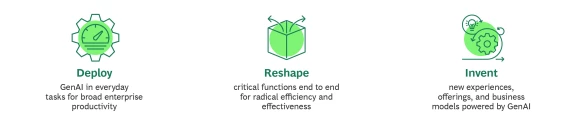
Test, improve and iterate

Here are the keys to getting started with generative AI and choosing the best path for your personal situation. 

But if you were to take just one piece of advice from this article, it would be this: don't miss out on the AI train that your competitors will jump on.


You might like

Klark blog thumbnail
- 5 MIN READING 

Service desk: definition, difference with help desk, features and complete guide 2025

Discover what a service desk is: complete definition, differences with help desk and ITSM, essential functionalities according to ITIL, comparison of the best software 2025, deployment guide and best practices for a high-performance service desk.
Klark's author
Co-founder and Co-CEO
Klark blog thumbnail
- 5 MIN READING 

Salesforce chatbot: methods, examples and best practices

Find out all about Salesforce chatbots: Einstein Bots vs. third-party solutions, integration, best practices, real-life use cases and how to choose the best option for automating your customer service.
Klark's author
Chief of Staff
Klark blog thumbnail
- 5 MIN READING 

Optimizing customer relations: the 5 essential steps to building loyalty

Discover the 5 essential steps to optimizing customer relations: customer knowledge, responsiveness, personalization, effective resolution and corporate culture. Methods, tools and case studies to boost loyalty.
Klark's author
Chief of Staff
Klark blog thumbnail
- 5 MIN READING 

Measuring customer satisfaction: the 7 key indicators (complete method)

Discover the 7 essential indicators for measuring customer satisfaction: CSAT, NPS, CES and more. Methods, tools and best practices to transform your data into concrete actions and boost customer loyalty.
Klark's author
Co-founder and Co-CEO
Klark blog thumbnail
- 5 MIN READING 

ROI customer service software: how to calculate and maximize your return on investment

Discover how to precisely calculate the ROI of customer service software: detailed formulas, key indicators, concrete examples with real figures (ROI from 300% to 1800%), and methods for maximizing your return on investment.
Klark's author
Chief of Staff
Klark blog thumbnail
- 5 MIN READING 

Customer satisfaction software: complete guide, best tools 2025 and comparison

Discover the complete guide to customer satisfaction software 2025: definition, key indicators (CSAT, NPS, CES), detailed comparison of the best tools on the market, how to choose and best practices for maximizing the value of your customer feedback.
Klark's author
Co-founder and Co-CEO