Is your call center ready for 2025? Or does it still operate as it did in the 2000s? 📞
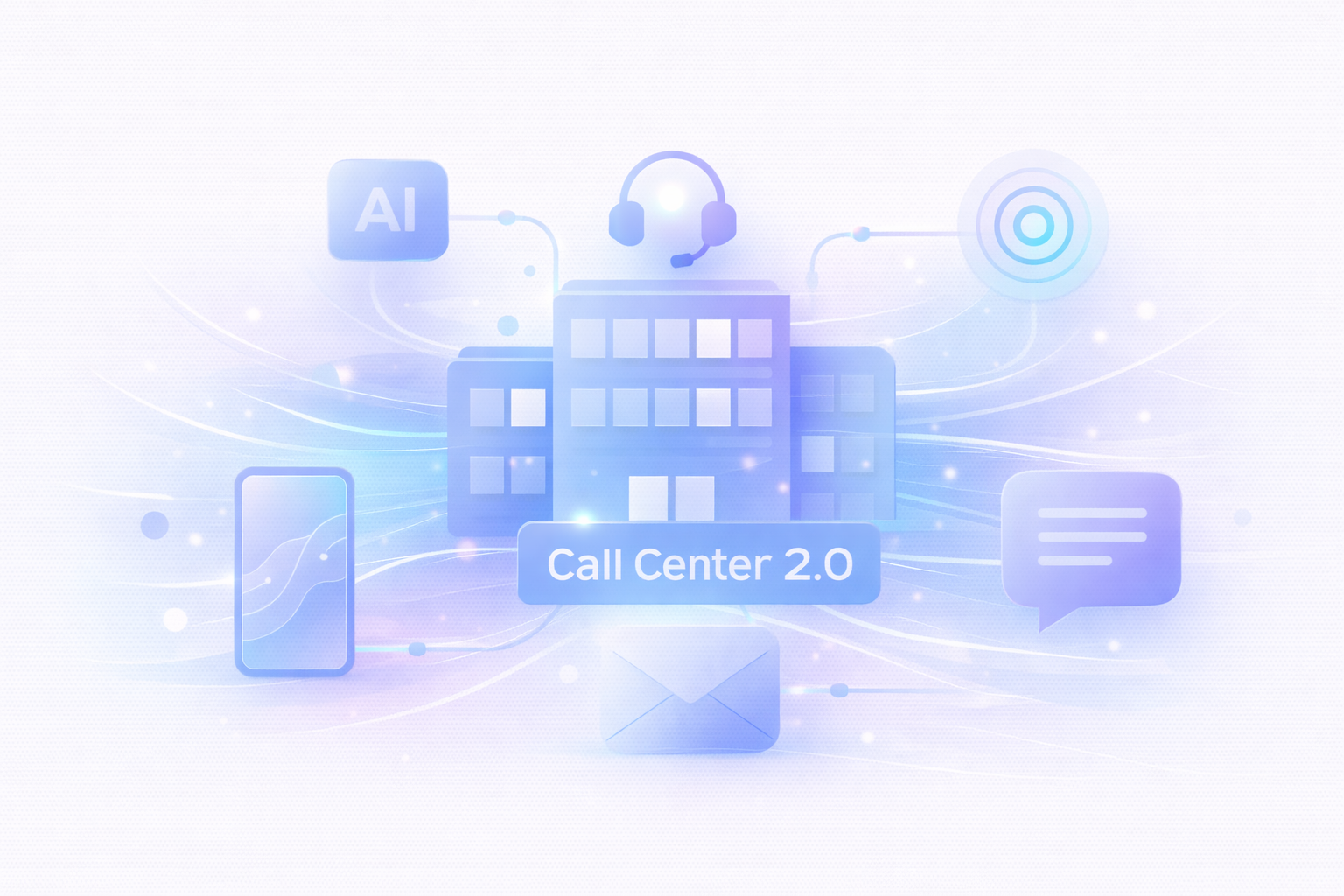
Call center 2.0 isn't just a marketing buzzword, it's a complete revolution in the way contact centers operate, integrate AI, and deliver an omnichannel experience to customers.
In this comprehensive guide, we'll explore what a call center 2.0 really is, the technologies that define it, how to make your digital transformation a success, real-life examples of companies that have done it, and best practices for moving from the traditional call center to the modern contact center.
Whether you're just thinking about it, or ready to transform your call center, this guide will give you everything you need to know. Let's get started! 🚀
What is a call center 2.0?
A call center 2.0 (or next-generation contact center) is the strategic evolution of the traditional call center into an omnichannel, AI-driven, cloud-based platform focused on the customer experience.
Key differences :
Traditional call center
Call center 2.0
Telephone only
Omnichannel (telephone, email, chat, social networks, SMS)
On-premise infrastructure
Cloud-native
Unattended single agents
AI co-pilot in real time
Reactive (waits for calls)
Proactive (anticipates needs)
Canals in silos
360° unified customer view
Manual peak management
Automatic scalability
Late reporting
Real-time analytics
Case in point:
Classic call center: A customer calls with a problem, then sends a follow-up email. The email agent doesn't see the phone history. The customer has to explain everything again. Frustration guaranteed. 😤
Call center 2.0: Customers contact us via the channel of their choice (chat, email, telephone). The agent instantly sees the entire history of all channels. An AI suggests relevant answers. Problem solved 3x faster. Satisfied customer. 😊
The figures that prove the urgency of transformation
The market speaks for itself:
Global contact center market to reach $407.1 billion by 2025
80% of companies will have integrated AI chatbots into their customer service by 2025
Organizations that deployed generative AI agents saw a 14% increase in problems solved per hour
Time spent on each query reduced by 9% thanks to AI
The omnichannel customer engagement market is expected to grow by 13% annually, reaching nearly $18 billion by 2030
The rate of automation in agent-customer communication is set to rise from 1.8% in 2022 to around 10% by 2026.
But here's the most revealing figure:
92% of customer relations departments use limited or compartmentalized tools
Only 8% use modern omnichannel solutions
But 80% of departments with less mature tools plan to invest in modern omnichannel solutions
The transformation is underway. Those who don't keep up will be left behind.
The 7 technological pillars of call center 2.0
1. Cloud-native infrastructure
No more physical servers in your basement. Call center 2.0 is 100% cloud.
Advantages :
Instant scalability: add agents in just a few clicks at peak times
Remote working: your agents can work from anywhere
Reduced costs: no heavy infrastructure to maintain
Automatic updates: always the latest version without intervention
High availability: 99.9% uptime guaranteed
2. Integrated omnichannel
The true call center 2.0 is not multichannel (several channels in silos), but omnichannel (all channels unified).
Integrated channels :
Telephone (voice)
Email
Live chat
Chatbot
SMS
Social networks (Facebook, Instagram, Twitter, WhatsApp)
Mobile applications
Self-service customer portal
The omnichannel experience: A customer starts a chat conversation on your site, then continues by email, then calls. The agent sees the entire history instantly on a single interface. Zero friction.
3. Generative artificial intelligence
Generative AI is radically transforming call center 2.0.
Transformation: Transition to an omnichannel 2.0 call center (phone + chat + mobile app + SMS) with AI.
Results :
60% of customers now prefer digital channels
Telephone waiting time reduced from 15 min to 2 min
40% of requests handled by self-service
NPS increased by 22 points
Mistakes to avoid when converting
Mistake #1: Changing everything at once
The big bang never works. Transform in stages.
Mistake #2: Neglecting agent training
The best tools are useless if your agents don't know how to use them. Invest in training.
Mistake #3: Forgetting to integrate with existing systems
A 2.0 call center that doesn't talk to your CRM is a 2.0 call center in silos. Integration is key.
Mistake #4: Buying AI without a strategy
There was a 15% increase in AI adoption in call centers between 2023 and 2025, but an average decrease of 0.5 points in customer and employee experience scores for the same period.
Why? Simply investing in AI is not the solution. You need to adapt your AI strategy and integrate it into your existing technological environment and processes.
Mistake #5: Ignoring agent feedback
Your agents are on the front line. Their feedback is invaluable. Involve them from the outset.
Future trends in call center 2.0
1. Proactive AI-based support
AI will no longer wait for customers to call. It will contact customers before they have a problem.
Example: "Hello, we've detected a problem with your order. We have already resolved it and here is your new tracking number."
2. Large-scale hyper-customization
Each interaction is adapted to the customer's history, preferences and context.
3. Immersive video support
Video interactions will become standard, allowing agents to visually demonstrate how to solve problems.
4. Advanced emotional AI
AI will understand not only what customers are saying, but also how they're feeling, and tailor responses accordingly.
5. Autonomous virtual agents
AI agents will no longer simply answer questions. They'll take action: processing refunds, modifying orders, solving complex technical problems.
Why choose Klark for your call center 2.0 transformation?
At Klark, we've built the most powerful AI platform for modern customer service:
Ultra-fast deployment: up and running in hours, not months
Klark is a generative AI platform that helps customer service agents respond faster and more accurately, without changing their tools or habits. Deployable in minutes, Klark is already used by over 50 brands and 2,000 agents.
Support information already exists in the FAQs, as well as in thousands of resolved tickets. The challenge is no longer just to write it down; it’s about finding the right source at the right time.
A good alternative to Intercom is judged based on integration, the role of the co-pilot, the pace of deployment, and the actual risk involved in the rollout.
Salesforce Einstein and Agentforce are part of the CRM system. Klark integrates with Salesforce to assist agents, without turning a support request into a CRM project.
Zendesk AI makes sense if Zendesk is the hub of your support operations. Klark is a better fit when your team wants to add cross-functional AI without changing its tools.