
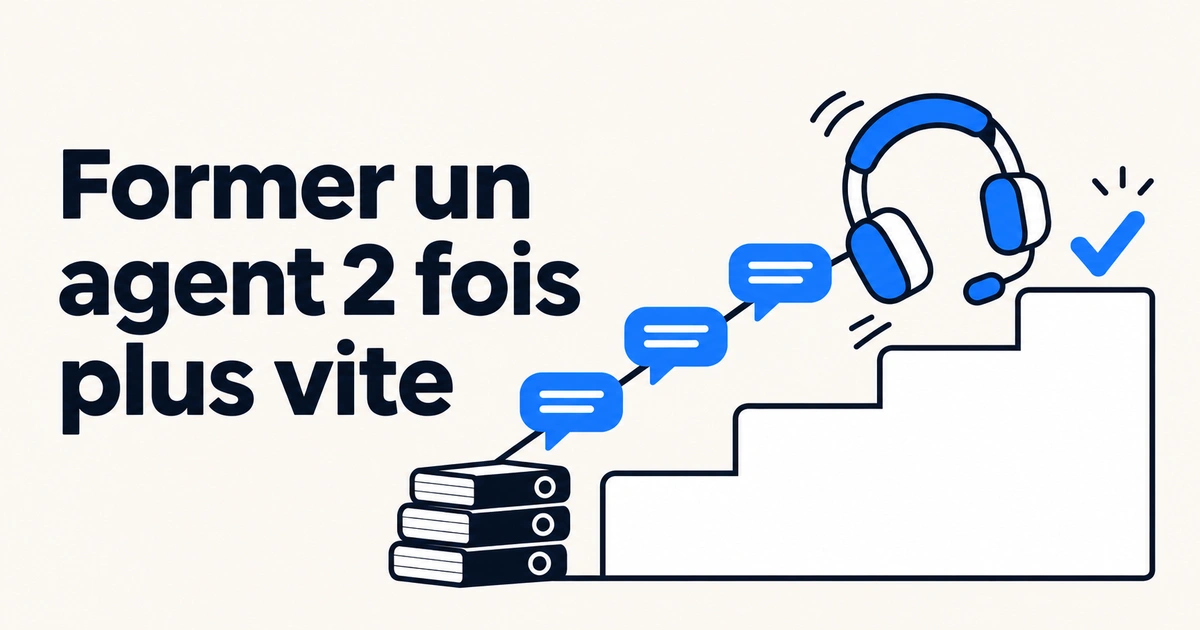
Train a new customer service agent twice as fast

To train a new customer service agent faster, they need a reply that follows the brand's processes and tone on every ticket from day one, instead of having to learn everything before becoming autonomous. That is what a customer service AI like Klark does: across our customers, a new agent's ramp-up time is cut in half. Whether seasonal, temporary or working for an outsourcing provider, the agent learns on the job, and the team's knowledge no longer depends on senior agents being available.
Key takeaways
- A new agent has to learn the processes, the tools, the brand voice and dozens of special cases: it takes several weeks to become autonomous.
- With Klark, the agent gets a prepared reply on every ticket from day one, built from the team's history.
- Across Klark's customers, ramp-up time is cut in half, and on average agents approve 60% of the replies drafted by Klark.
- Senior agents spend less time answering newcomers' questions and more time on difficult cases.
Why does training a new customer service agent take so long?
An e-commerce agent needs more than good writing. They have to know when return shipping is refunded, which carrier delivers which area, how to handle a parcel marked as delivered but never received, and which tone to use with an unhappy loyal customer.
Much of this knowledge is written down nowhere. It lives in experienced agents' heads and in thousands of past tickets. So the new agent asks questions, and every question interrupts a senior.
The problem repeats with every new arrival:
- Seasonal staff arrive just before the peak, the worst time to train.
- Temporary staff stay a few weeks: they leave as soon as they are trained.
- Outsourced (BPO) agents discover the brand remotely, without the team's habits.
- Turnover resets the counter to zero with every departure.
Hiring itself is already hard. An e-commerce leader told our sales team as much in November 2026: he is "struggling to hire" in customer service. Once the right person is found, every week of training counts.
What does a new agent need to learn, with and without AI?
| What to master | Without AI | With Klark |
|---|---|---|
| Processes (returns, refunds, carrier disputes) | Learned by heart or asked of seniors | Applied in the prepared reply, which the agent reviews |
| Brand voice | Learned by rereading past conversations | Taken from historical tickets, from the very first reply |
| Special cases | Discovered through mistakes | Flagged by Klark, which has already seen similar cases |
| Context of a long conversation | Reread message by message | Ticket summarized in a few lines |
| Foreign languages | Copy-pasted into a translator | Translation and reply in the customer's language |
| Recurring requests (parcel tracking, invoices) | Handled one by one | Resolved autonomously, outside what needs to be learned |
How does Klark cut a new agent's training time?
Klark connects to your helpdesk (Zendesk, Gorgias, Freshdesk, Salesforce, Intercom, HubSpot…) and learns from your historical tickets and your knowledge base. For a new agent, this changes three things.
A compliant reply on every ticket, from day one
On every ticket, the agent finds a reply prepared by Klark that applies the brand's processes and tone. They review it, adjust it if needed and send it. They learn by seeing, ticket after ticket, how the team replies. This is copilot mode.
The team's knowledge becomes accessible
Senior agents' knowledge is already in the tickets they have handled. Klark makes it usable by everyone: we explain how in our article on the knowledge base built from tickets. The new agent asks fewer questions, and seniors are interrupted less.
Fewer requests to learn
Klark resolves part of the requests autonomously, with or without an action in your tools: parcel tracking, invoice, return label, order cancellation. It does this by email, on your website chatbot and over the phone with the voicebot. The new agent does not need to learn these cases: they focus on those that require real judgment.
What results do Klark's customers see?
- Ramp-up time cut in half for a new agent.
- 60% of replies drafted by Klark approved by agents, on average.
- +50% productivity on average for teams.
The customer service manager at a brand that uses Klark describes the change in his team: "Seniors spend less time on repetitive tickets. Juniors focus on customer satisfaction rather than on writing."
How do you organize a new agent's onboarding with AI?
Here is the sequence we recommend to teams welcoming seasonal or temporary staff.
- Before arrival: check that key processes (returns, refunds, disputes) and the brand voice are up to date in your knowledge base. Klark relies on it.
- Day 1: introduce the brand, the products and the tools. The agent handles their first tickets with the reply prepared by Klark, under a senior's eye.
- Week 1: the agent handles the most frequent contact reasons alone. The senior reviews a sample of sent replies each day rather than every ticket.
- Weeks 2 to 4: the agent takes on trickier cases. Every correction they make to a Klark reply is a chance to learn, and to adjust the guidelines.
- Follow-up: measure the rate of replies approved without changes, handling time and the satisfaction of customers handled by the agent.
This approach is especially useful before a busy period: we detail it in our article on Black Friday and sales peaks.
What limits should you keep in mind?
- The agent must review. A prepared reply still needs checking, especially in the first weeks. The review habit is part of the training.
- Product knowledge still has to be passed on. Advising on a size or a material requires knowing the catalog: plan time for it.
- Sensitive cases stay human. An angry customer, a dispute or a goodwill gesture call for judgment and a manager's approval.
- Quality depends on content. If a process changes, update it in the knowledge base before newcomers arrive.
To choose a tool more broadly, see our guide to AI for customer service.
Discover Klark
New agents up to speed faster
See how Klark prepares a reply that follows your processes on every ticket, from a seasonal agent's first day.
Book a free demoFrequently asked questions
How can you reduce a new customer service agent's training time?
Give them a prepared reply that follows your processes on every ticket from day one. An AI like Klark, which learns from the team's historical tickets, lets them learn on the job. Across Klark's customers, ramp-up time is cut in half.
How long does it take to train a customer service agent?
It depends on how complex your processes and catalog are. It usually takes several weeks for an agent to become autonomous. With a prepared reply on every ticket, they handle the most frequent contact reasons from the first week.
Is AI suitable for seasonal, temporary and outsourced agents?
Yes, they benefit the most, because they need to be operational quickly and stay for a short time. They work in the usual helpdesk, with Klark's reply on every ticket.
Do agents really approve the AI's replies?
Across Klark's customers, agents approve 60% of the replies drafted by Klark on average. The others are adjusted before sending.
Do you still need senior agents on the team?
Yes. They handle difficult cases, review newcomers' replies and keep processes up to date. They are simply interrupted less by repetitive questions.