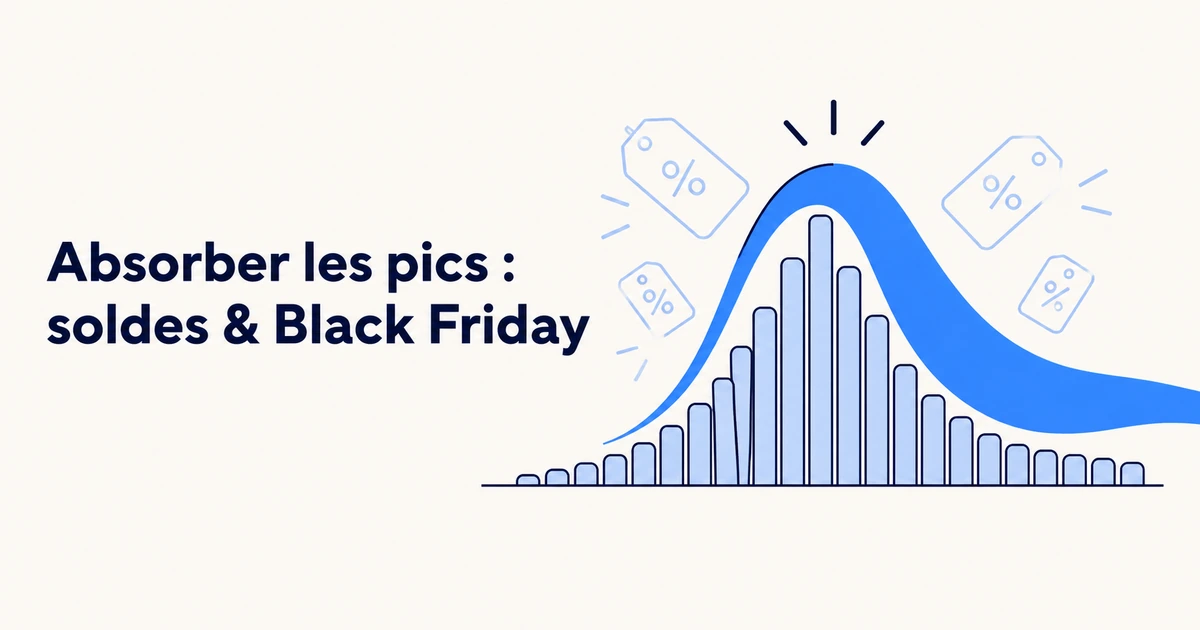
Black Friday is coming up, and are you already worried about your ticket queue? 🤔 That's normal: in just a few days, the volume of requests can double—sometimes even more.
The short answer: To handle a surge, combine three strategies. Reduce avoidable interactions (self-care, proactive order tracking). Automate repetitive requests with AI. And reserve your agents for cases that require judgment.
Additional staff (temporary workers, outsourced workers) are still useful. But they have to be arranged weeks in advance, and they don't always keep pace with changes in volume.
In this guide: the 2026–2027 calendar, the true scale of the peaks, a comparison of the 5 options, a preparation plan for D-60 through D+15, the KPIs to track, and mistakes to avoid.
Let's go! 🚀
A customer service surge doesn't last just one day. It stretches out over several weeks, from Black Friday Week through the January returns season.
Winter sales: Dates calculated in accordance with the Commercial Code and included in the published schedules. To be confirmed by the government’s official announcement.
How these dates are set:
Black Friday falls on the day after Thanksgiving, which is celebrated on the fourth Thursday of November in the United States. In 2026, Thanksgiving falls on Thursday, November 26.
In France, the winter sales begin on the second Wednesday of January at 8 a.m. Exception: If that Wednesday falls after the 12th, the sales begin on the first Wednesday. In 2027, the second Wednesday is January 13; therefore, the sales begin on January 6 and last for four weeks.
Two useful points to note:
If you also sell internationally, check the dates for each country. In Luxembourg, for example, the 2027 winter sales run from January 2 to 30.
The figures vary by sector and business model. But the trend is clear: volume is rising sharply, and the nature of the requests is changing.
Available reference points:
Concentrix is a customer relationship management outsourcing provider: its figures are industry averages, which should be compared with your own historical data.
In plain English?
Your own history remains the best source. But most e-commerce brands should expect their volume to at least double. And they should expect a much higher proportion of simple, repetitive questions: package tracking, delivery times, and returns.
That's good news. These requests are, in fact, the easiest to anticipate and automate.
A surge doesn't just make the line longer. It sets off a snowball effect.
The backlog feeds on itself:
When a response is delayed, the customer follows up—first by email, then via chat, and then on social media. A single question turns into three support tickets.
Quality is declining:
When under pressure, agents work faster and check things less thoroughly. Mistakes lead to new leads.
Reinforcements arrive too late or too early:
Volume increases within a few hours, but it takes several weeks to recruit and train additional staff. The result: either you oversize your staff as a precaution, or you suffer the consequences.
The spike continues:
After Black Friday come Christmas deliveries, followed by gift returns, and then the sales. For an e-commerce retailer, the peak season often lasts from mid-November to early February.
There is no one-size-fits-all solution. The best-prepared teams combine several approaches.
Principle:
Hire temporary staff or bring in employees from other departments for the peak season.
Strengths:
Limits:
Principle:
Outsource a portion of the customer interactions to a specialized service provider, often within a defined scope (Level 1, certain channels, certain time slots).
Strengths:
Limits:
Principle:
Preventing Contact Before It Happens: Updated FAQ, Order Tracking Page, Proactive Emails in Case of Delays, Website Banner.
Strengths:
Limits:
Principle:
The AI drafts a response for each ticket. The agent reviews it, makes any necessary adjustments, and sends it. That's the Klark Copilot approach.
Strengths:
Limits:
Principle:
The AI handles simple requests on its own via chat, email, or forms. It escalates to a human when it doesn't know how to handle a request. To learn more, see our definition of a chatbot.
Strengths:
Limits:
Qualitative estimates: Actual costs and timelines depend on your volume, your tools, and your service providers.
How do you read this table?
Human resources are still necessary for complex cases. But they’re inflexible: you pay for capacity, not usage. Digital tools, on the other hand, scale with actual volume. That’s why it makes sense to combine them.
Here is a sample reverse schedule based on Black Friday, November 27, 2026. Adapt it for the winter sales by shifting the date to January 6, 2027.
Review last year's tickets, week by week. Identify the peak, its duration, and the top 10 reasons for contact. Apply your projected business growth.
Calculate the gap between current capacity and projected volume. Decide what will be handled through self-care, automated (AI), and handled by humans. Start recruiting or initiate the BPO contract now, if necessary.
Update the FAQs, macros, and return policy. Check the Christmas shipping deadlines. Run the AI in assisted mode to measure the actual quality of your support tickets.
Set up support teams for the main features. Test the escalation procedures for human support. Prepare responses to likely incidents: out-of-stock situations, shipping delays, and promo code bugs.
Send proactive communications (deadlines, return policies). Block out vacation time. Schedule a daily meeting between customer service, logistics, and marketing.
Track the KPIs several times a day. Reassign agents to different queues. Then, on Day 15, prepare a written report: it will be used for the January sales.
During a peak period, a few metrics are enough. It's better to track five KPIs every hour than to check twenty once a week.
Incoming volume by channel and reason:
It identifies problems before they escalate. A sudden spike in a particular pattern often signals an issue (payment, carrier, inventory).
Backlog (pending tickets):
Warning indicator #1. If it rises for several hours in a row, action must be taken: call in reinforcements, reassign staff, or send a proactive message.
First response time:
The time it takes to provide the first response to a customer. Set realistic goals for each channel, consistent with your SLAs.
Average processing time:
It measures agent productivity. See our definition ofAHT.
Automation rate and escalation rate:
The percentage of tickets resolved without human intervention, and the percentage that AI forwards to an agent. The two should be considered together.
Customer satisfaction:
CSAT confirms that speed has not come at the expense of quality. Combine this with the FCR: a ticket resolved on the first try means one fewer follow-up.
Prepare only on the day of the event:
Black Friday doesn't last 24 hours. WISMO peaks during the shipping season, and returns start coming in during January. Plan your capacity for the entire season.
Hiring Too Late:
A new hire recruited during Black Friday week will be trained… after the peak. Hiring decisions must be made no later than 45 days before the event.
Run an AI model the day before the peak:
Deploying AI without testing it on your actual tickets poses an unnecessary risk. Start by using assisted mode a few weeks beforehand.
Forget the content:
Outdated FAQs, out-of-date return policies, poorly documented promo codes: both your agents and your AI will give the wrong answers.
Failing to prioritize proactive communication:
An email notifying customers of a delay prevents dozens of “Where’s my order?” inquiries. It’s often the most cost-effective strategy.
Do not take stock:
Winter sales begin five weeks after Black Friday. A timely debrief will help you avoid repeating the same mistakes.
Klark is a French generative AI platform designed for retail and e-commerce. It helps teams handle more tickets during peak periods by reducing the need for additional staff.
Three complementary building blocks:
Why it's suitable for peaks:
The AI learns from your ticket history. No need to design an if/then/else workflow. You can launch it a few weeks before Black Friday without a complex project.
Klark integrates with your help desk (Zendesk, Freshdesk, Gorgias, Salesforce, Intercom, Front, HubSpot, Crisp, eDesk). For package tracking, it uses data from connected tools such as Shopify, Shipup, or ShippingBo. See also our comparisons of Klark vs. Gorgias and Klark vs. Zendesk.
Flat-rate subscription + €0.50 per successfully processed ticket. During peak season, the variable portion is based on actual volume; during off-peak season, it decreases. A ticket is billed only once, even if Klark drafts multiple responses.
On average, Klark's customers see a 50% increase in productivity and 43% of tickets automated. At Upway, 80% of the requests received by the chatbot are automated, representing approximately 45% of the total Level 1 volume.
Limitations, in full transparency:
"We were drowning in repetitive tasks… until Klark came along." — François, CEO of NV Gallery
When should we start preparing for Black Friday 2026 from a customer service perspective?
Ideally, two months in advance, or by the end of September 2026. That’s the time needed to forecast volume, hire as needed, and test the automation.
By how much does the volume of tickets increase during Black Friday?
According to Concentrix, contact volumes are roughly double the normal level, with peaks of three to five times the normal volume in some models. Your history remains the most reliable reference.
Which requests should be automated first during a peak?
Order tracking (WISMO), delivery times, return policies, and questions about promo codes. These are the most common and frequently asked questions.
Can AI replace seasonal workers?
It can reduce the need for them, but not eliminate them. Complex and sensitive cases always require a human. AI frees up your agents so they can focus on those cases.
When is the 2027 winter sale?
According to the provisions of the Commercial Code, from Wednesday, January 6, to Tuesday, February 2, 2027, in most departments. Be sure to check the official announcement.
Let's recap:
A good strategy combines these factors. And the right time to launch it is now, not the day before Black Friday.
The goal isn't to have your team working at full capacity for three months. It's to enable them to serve your customers well, even when volume skyrockets. 🚀
About Klark
Klark is a generative AI platform that helps customer service agents respond faster, more accurately, without changing their tools or habits. Deployable in minutes, Klark is already used by over 50 brands and 2,000 agents.