
Improve customer satisfaction by answering faster with AI

Yes, a well-deployed customer service AI improves customer satisfaction, because it cuts response time without hurting answer accuracy. At Kusmi Tea, CSAT went from 70 to 85 and NPS from 28 to 53 with Klark; at Izipizi, CSAT gained 1.5 points in one year, from a base already above 93%.
The opposite fear is legitimate: an AI that answers off the mark, in a robotic tone, and creates more work than it removes. Here is what raises satisfaction, what lowers it, and how to check it for your brand.
Key takeaways
- Response time is one of the main drivers of satisfaction: a customer who waits follows up, and a customer who follows up is already less satisfied.
- A customer service AI saves time at two levels: it resolves part of the requests on its own and prepares the answer for agents on the rest.
- Results at Klark customers: Kusmi Tea +15 CSAT points and +25 NPS points, Izipizi +1.5 CSAT points in one year.
- Satisfaction drops when the AI answers without reliable data or does not hand over in time: these are the two points to check.
Why do brands fear that AI will hurt satisfaction?
Many teams have already tested a tool that let them down. A customer service manager at a cosmetics brand handling around 200 tickets a day told us in November 2026: "I always have this slight apprehension about launching an AI tool. I hope it won't create extra work for me." In a previous trial, she had to go back over every ticket.
The fears usually take three forms:
- Wrong answers: an invented delivery time, a misread return policy, a refund announced that never happened.
- A tone that doesn't sound like the brand: too formal, too generic, or on the contrary too casual.
- A stuck customer: an AI that goes round in circles instead of handing over to a human.
These risks are real. They depend mostly on how the AI is connected to your data and on its handover rules.
How does response speed affect CSAT and NPS?
CSAT measures satisfaction after an interaction, NPS the likelihood of recommending the brand. Both are sensitive to delay: a customer who waits one or two days for an answer follows up, gets annoyed and rates more harshly, even if the final answer is right.
Expectations are rising. According to Zendesk's CX Trends 2026 report, 88% of consumers expect faster answers than a year ago, and 74% expect customer service to be available 24/7.
An AI acts on this delay in two ways:
- By resolving part of the requests on its own, at any hour: the answer arrives in seconds instead of hours.
- By speeding up agents on the rest: the answer is ready, the agent checks it and sends it. The queue empties faster for everyone, including complex requests.
How does Klark improve customer satisfaction?
Klark is a customer service AI built for retail and e-commerce. It connects to your helpdesk and your tools, and works across email, the website chatbot and the phone.
Answers based on order data
Klark checks the order, the carrier or the returns platform before answering. It can also act: issue a return label, send an invoice, cancel an order before shipment. The customer gets an accurate answer and a completed action, with no back-and-forth.
Your brand's tone
Klark learns from your ticket history and your content. Answers follow the way your team writes to your customers. Agents can adjust an answer in one click before sending it.
The right language
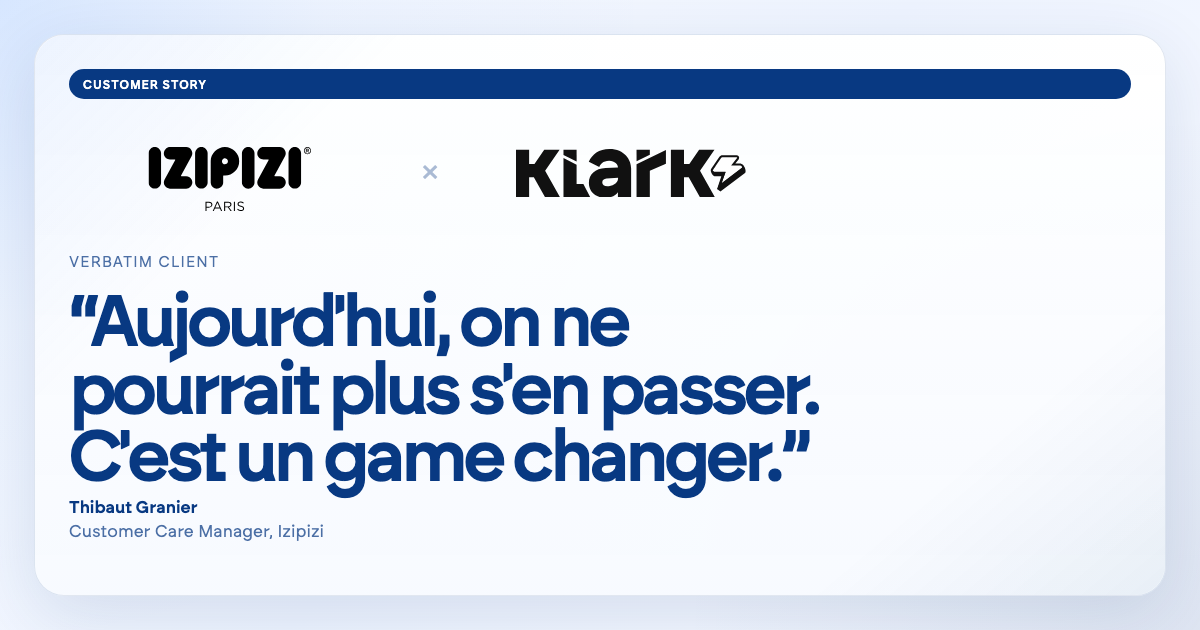
Klark answers in the customer's language and translates the conversation for the agent. At Izipizi, where part of the customers write in German, translation played a part in the improvement: "Talking to our customers in their own language is a real change," says Thibaut Granier, Customer Care Manager.
A handover to a human when needed
Sensitive cases, such as a dispute or a very unhappy customer, are passed to an agent with the conversation context. The customer does not have to repeat themselves.
What results have Klark customers seen?
| Brand | Indicator | Result with Klark |
|---|---|---|
| Kusmi Tea | CSAT | From 70 to 85, i.e. +15 points |
| Kusmi Tea | NPS | From 28 to 53, i.e. +25 points |
| Izipizi | CSAT | +1.5 points in 12 months, from a base above 93% |
| A stationery brand | CSAT | +5 points |
| A fashion brand | Answers sent within 24 hours | +50% |
Izipizi's case shows that you can gain points even from a very high base. The team also resolves around 800 tickets a month automatically. Read the Izipizi case study for details. More results are presented on our customers page.
These results come on top of productivity: on average, Klark customers see +50% productivity and 43% of tickets automated. The time freed up is reinvested in the requests that matter most for satisfaction.
Copilot, automation or both: which mode for which goal?
| Mode | What it changes for the customer | Best for |
|---|---|---|
| Copilot (answer prepared, approved by the agent) | Faster answer, reviewed by a human | Brands getting started, or whose requests often call for a goodwill gesture |
| Autonomous resolution (email, forms) | Answer and action within minutes, at any hour | Brands with many requests about orders, delivery and returns |
| Chatbot and voicebot | Immediate answer while browsing or on a call | Brands with pre-purchase questions and a high call volume |
Most Klark customers combine all three. One limit to keep in mind: AI does not fix a policy customers misunderstand or a logistics problem. If delivery delays explain most of your bad ratings, satisfaction will mainly recover when delivery improves.
How do you measure the effect of AI on satisfaction?
- Set the baseline. Record CSAT, NPS and first response time over the three months before deployment.
- Separate the flows. Compare the CSAT of tickets resolved by the AI, tickets handled with a prepared answer and tickets handled without AI.
- Track by reason for contact. A CSAT drop on a single reason usually signals a rule to fix for that reason.
- Read the comments. Customer comments quickly show whether tone or accuracy is a problem.
- Compare like-for-like periods. December CSAT is compared with the previous December.
To dig deeper into measurement, read our article on measuring customer satisfaction with generative AI.
Discover Klark
Improve your CSAT by answering faster
See how Klark answers your customers faster, with their order data and your brand's tone.
Book a free demoFrequently asked questions
Does customer service AI really improve CSAT?
Yes, when it answers faster with accurate information. At Kusmi Tea, CSAT rose from 70 to 85 with Klark, and at Izipizi it gained 1.5 points in one year from a base already above 93%.
Can AI lower customer satisfaction?
Yes, if it answers without reliable data or fails to hand sensitive cases to a human in time. That is why Klark relies on order data and passes to an agent the requests it should not handle alone.
Can customers tell they are talking to an AI?
Answers follow your brand's tone. You decide how you present the assistant to your customers, in line with your obligations to disclose the use of AI.
How long does it take to see an effect on CSAT?
Response time drops in the first weeks. The effect on CSAT shows over several months, compared with an equivalent period of the previous year.
Should you automate or keep a human in the loop for satisfaction?
The two work together. Autonomous resolution speeds up requests about orders, delivery and returns; prepared answers speed up agents on requests that need judgement.