
Answer customers 24/7 without on-call duty with e-commerce customer service AI

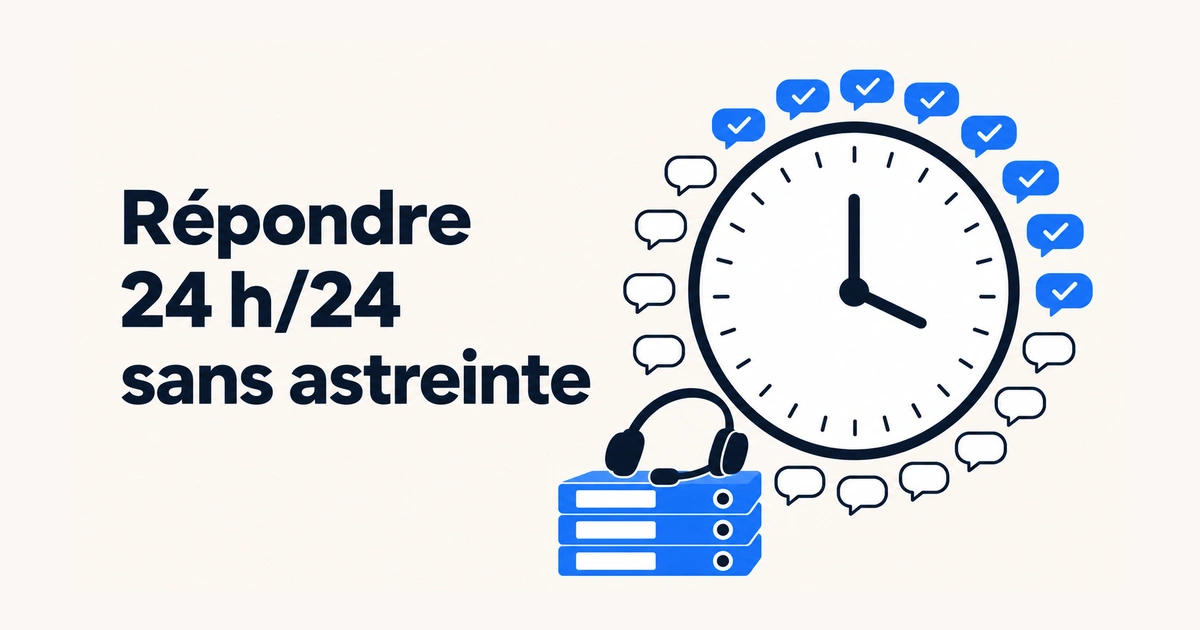
To answer customers 24/7 without putting your team on call, hand evening and weekend messages to an e-commerce customer service AI that resolves requests on its own, actions included, and leaves your agents only the cases that need a human decision. On Monday morning, the team finds just a few cases, already summarized and ready to be settled.
The need is real. At one of Klark's e-commerce customers, 47% of the messages received in October 2026 arrived outside office hours. This guide explains where this flow comes from, the options to cover it, what Klark does and how to set it up.
Key takeaways
- Nearly one customer message in two can arrive in the evening, at night or on the weekend: at one of Klark's e-commerce customers, 30% in weekday evenings and nights, 17% on weekends.
- Human on-call duty is expensive and wears the team down; an automatic "we'll get back to you on Monday" reply solves nothing.
- A customer service AI can resolve these requests on its own at any hour: parcel tracking, return label, invoice, order cancellation, product questions.
- Requests that need a human decision stay in the queue, already qualified, for when the team opens.
Why do so many customers write in the evening and on weekends?
Your customers shop when they have time: after work, on Sundays, on their commute. They write at the same moments, often right after ordering or when the parcel arrives. A customer who receives a damaged item on Saturday morning wants to know on Saturday how to return it.
Expectations follow. In a survey of 1,023 French people conducted in October 2022 by CM.com with CANDID, 72% of respondents want to be able to reach customer service at any time of day or night. More than 70% expect 24/7 availability.
The field data is in the same range. At one of Klark's e-commerce customers, over the month of October 2026:
| Time slot | Share of incoming messages |
|---|---|
| Office hours, weekdays | 53% |
| Evenings and nights, weekdays | 30% |
| Weekends | 17% |
In other words, nearly half the flow waits for the team to return. Monday starts with the weekend backlog, and first response time gets longer for everyone, including customers who write on Monday.
What happens when nobody answers outside office hours?
A customer without a reply follows up. They write a second email, then use the form, then leave a review. A single question becomes three tickets, which an agent then has to merge.
Urgent requests are also the ones that arrive outside office hours: an order to cancel before Monday's shipment, a wrong delivery address, a parcel marked as delivered but nowhere to be found. Every hour counts for these cases. By the time the team opens them, it is sometimes too late to act.
Finally, Monday weighs on the team. Agents start the week behind, sort instead of resolving, and answer fast rather than well. It is a common source of burnout in e-commerce customer service teams.
What are the options to cover evenings and weekends?
Five solutions coexist. They do not cost the same and do not solve the same requests.
| Option | What it covers | Limits | Best for |
|---|---|---|---|
| In-house on-call duty or extended shifts | Everything, with the judgment of a brand agent | Cost of premiums, fatigue, hard to sustain in a small team | Brands with high stakes per contact and a team large enough to rotate |
| Outsourcing (BPO) with extended hours | High volume, several languages | Training time, variable quality on brand voice, cost per hour covered | Large stable volumes, well-documented processes |
| FAQ, tracking page and automatic holding reply | Questions with a public answer | The customer has to search alone; no action on their order | All brands, as a complement |
| Scripted chatbot | Journeys planned in advance | Stuck as soon as the question leaves the script; decision trees to maintain | Simple catalogs, few contact reasons |
| Autonomous customer service AI | Email, form, chat and phone requests, with actions in your tools | Requires connecting your tools and an up-to-date knowledge base; cases needing a decision wait for the team | E-commerce brands with a regular after-hours flow |
These options can be combined. A good order tracking page already reduces volume; the AI takes the rest; on-call duty can be limited to rare critical cases.
How does Klark answer customers 24/7?
Klark is an omnichannel customer service automation solution. It connects to your helpdesk and your tools (store, carrier, returns management) and resolves your customers' requests on its own, in writing and by voice, at any hour.
On the website: the chatbot
The Klark chatbot answers visitors live, before and after purchase: choosing a size, product availability, order tracking, return process. At the e-commerce customer mentioned above, 70% of chatbot conversations are resolved without human intervention.
By email and form: autonomous ticket resolution
When a ticket arrives at 11 p.m., Klark reads it, finds the order and acts if needed: it gives the parcel tracking, issues the return label, sends the invoice or cancels the order before shipment. The customer gets their answer right away, without waiting for Monday. At the same customer, 44% of the replies sent automatically concern messages that arrived outside office hours.
An example of a Sunday evening ticket: "Hello, I ordered on Friday and entered the wrong address, can you cancel?" Klark checks that the order has not shipped yet, cancels it and confirms to the customer, who can order again that evening.
By phone: the voicebot
Evening and weekend calls no longer go to voicemail. The Klark voicebot picks up, understands the request and handles it like a written ticket.
And when the AI should not decide?
A dispute, a request for a goodwill gesture outside the rules, an unhappy customer: Klark does not decide in your team's place. It acknowledges the request, tells the customer when they will get an answer, and leaves the ticket in the queue with a summary and the order already retrieved. Monday's agent saves the search time.
What results can you expect from an e-commerce customer service AI at night?
Across all its customers, Klark automates 43% of tickets on average and brings teams +50% productivity on average. More than 150 brands use Klark today.
The first effect shows in after-hours response time: requests resolved by the AI go out within a minute instead of waiting for opening time. The second shows on Monday: the queue holds fewer tickets, and those that remain are already qualified.
An honest caveat: not every customer wants to talk to an AI. In the 2022 CM.com survey, a large majority of respondents still preferred a human advisor during office hours to a chatbot available 24/7. Nearly 30% of under-35s made the opposite choice. What these customers want above all is a solution that fixes their problem: 7 in 10 prefer an effective answer to an instant but less relevant one. The useful measure is therefore the rate of requests actually resolved.
How do you set up 24/7 replies without on-call duty?
- Measure your after-hours flow. Export a month of tickets from your helpdesk and break them down by time slot and contact reason. You will know what share arrives in the evening and on weekends, and why.
- Choose the reasons to resolve autonomously. Order tracking, returns, invoices, cancellations and product questions often cover most of the evening flow.
- Connect the tools. Helpdesk, store, carrier and returns tool: this is what lets the AI act instead of promising an answer.
- Set escalation rules. Write down the cases that wait for a human, and the message the customer receives in that case.
- Start, then review every week. After-hours autonomous resolution rate, Monday morning volume, satisfaction with night-time replies. Adjust the knowledge base based on escalated tickets.
To go further on response time, read our guide to first response time. For the most frequent evening reason, see how to automate "Where is my order?" replies. If your year-end peaks also fall on weekends, our plan to absorb Black Friday and sales peaks complements this use case. For an overview, see our page on customer service AI and the one dedicated to the AI chatbot for e-commerce.
Discover Klark
Do your customers write in the evening too?
See on your own tickets what Klark would resolve on its own outside your opening hours.
Book a free demoFrequently asked questions
Can you provide 24/7 customer service without hiring?
Yes, if a customer service AI takes care of evening and weekend requests. It resolves on its own those it can handle, actions included, and keeps the others in the queue for the team. Nobody needs to be on call.
Which requests can an AI resolve at night?
The most frequent evening reasons: parcel tracking, returns and return labels, invoices, cancellation of an order not yet shipped, questions about a product or a size. Disputes and goodwill gestures outside the rules wait for an agent.
What does the customer see when their request has to wait for a human?
They receive a clear acknowledgment telling them when they will get an answer. Their case is already summarized for the agent, who does not have to ask the same questions again.
Do you need to change helpdesk to answer 24/7 with Klark?
No. Klark connects to your existing helpdesk and your e-commerce tools. Your agents keep working in the same tool.
How do you measure the impact on customer service?
Track three metrics: the share of after-hours requests resolved without a human, the number of pending tickets on Monday morning and satisfaction with replies sent at night. Compare them with the month before setup.