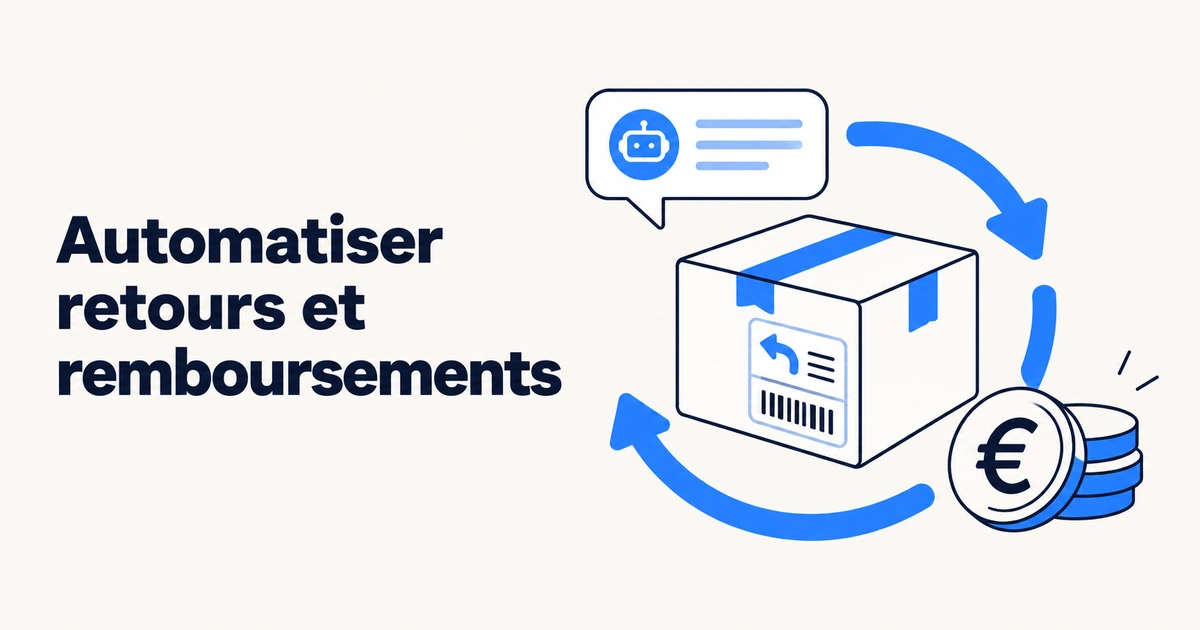
"How do I return my item?", "Where is my refund?", "Did my return arrive?" Do these messages sound familiar? 🤔
Returns are one of the most common topics in an e-commerce customer service inbox. And they're almost always the same questions.
The short answer:
Yes, most return-related requests can be automated: information on the return policy, eligibility checks, label generation, tracking of return shipments, and refund status. Disputes (damaged products, returns received after the deadline, dissatisfied customers, goodwill gestures) should remain in the hands of a human.
In this guide, we'll look at what the law says, what processes are truly automated, the available tools, and how to get started without compromising the customer experience.
Let's go! 🚀
Behind the word “return” lie two distinct topics.
1. The Logistical and Financial Process
The customer reports the return, receives a shipping label, and drops off the package. The warehouse receives and inspects the item, and then the refund or exchange is processed. This is where return portals and logistics tools come into play.
2. Conversations About Returning Home
These are all the messages the customer sends at each stage: before returning an item, during shipping, and after receiving it. These requests come in via email, chat, forms, or social media. This is where the help desk and AI come into play.
Automating feedback means killing two birds with one stone. A good portal reduces the number of questions. Good AI responds quickly and accurately to the questions that do come in.
Returns are not a marginal issue. Here are a few recent examples:
What about customer service?
There are few reliable public statistics on the exact percentage of support tickets related to returns. An academic study conducted in collaboration with Alibaba (2026) indicates that 56.5% of after-sales conversations on a marketplace concern order-related issues: returns, refunds, exchanges, repairs, or shipping costs.
The most reliable method is still your own tracking. Track tickets by reason for a month: you'll know exactly how many returns you're handling.
This latest figure from Narvar says it all: a customer who doesn't know the status of their refund writes to you. And sometimes, they stop buying.
An incorrect automated response on a legal matter is a risk. Your AI, macros, and portal must reflect current regulations. Here are the key points regarding distance selling in France, as presented by Service-Public.fr.
Points to keep in mind:
Right of withdrawal or warranty?
Do not confuse the right of withdrawal (the customer changes their mind) with the legal warranty of conformity (the product is defective), which is valid for two years from the date of delivery. The rules and responses are not the same. Your automation system must be able to distinguish between the two and escalate the issue when in doubt.
This reminder does not constitute legal advice. Have your terms and conditions and response templates reviewed by a lawyer.
Not all return requests are the same. The best approach is to categorize them based on their level of risk.
Return Policy Information:
Delivery times, fees, terms and conditions, excluded items, and whether or not in-store returns are allowed. These are consistent answers that are easy to verify.
Eligibility Check:
Delivery date, product category, time elapsed. With the order data, the answer is factual.
Label Creation and Return Instructions:
A redirect portal handles this very well. The AI can redirect users to the right link at the right time.
Tracking your return package:
"Did you receive my return?" The answer depends on the carrier's status or whether it has been received at the warehouse.
Refund Status:
"When will I be reimbursed?" If that information is available on your e-commerce platform, the answer can be automatic and accurate.
Golden Rule:
Automate the information, not the binding decision. AI that promises a refund or a goodwill gesture not provided for in your policy creates a commitment that you will have to honor.
Several families of tools coexist. They are not in competition with one another; rather, they complement one another.
They automate the logistics process: the customer submits a self-service return request, chooses between a refund or an exchange, and receives a return label.
Loop Returns
A U.S.-based platform with a strong presence in the Shopify ecosystem (claiming over 5,000 Shopify brands). It excels in returns and store credit. In February 2026, Loop announced an integration with Sendcloud to expand its carrier network to the United Kingdom and the European Union.
ReturnGO
Self-service returns portal, compatible with multiple e-commerce platforms, featuring a Shopify app.
Revers.io
A French platform (based in Paris) dedicated to after-sales services: returns, repairs, and resale. It lists clients such as Fnac Darty, La Redoute, and Maisons du Monde.
Shipup (by ZigZag)
A post-purchase platform that includes delivery tracking and a returns portal. It integrates with Gorgias, Zendesk, and Salesforce, among others.
Gorgias, Zendesk, and others offer their own AI agents. On Gorgias, the AI Agent has native access to Shopify data, including returns. For details on the options available for this help desk, see our comparison of AI solutions compatible with Gorgias.
That’s Klark’s approach. The AI integrates with your existing help desk and tools (Shopify, PrestaShop, Magento, Shipup, ShippingBo, etc.). It uses this data and your ticket history to draft or send responses to return requests.
Retail prices as of 2026; please check with each publisher.
The right combination?
In most cases: a return portal for the process, and an AI on the help desk for any questions that still come in.
Tag your tickets by reason for at least one month: terms and conditions, eligibility, label, return tracking, refund status, defective product. You'll know where the volume is.
Time frames, fees, exclusions, in-store returns, exchanges, or store credit. If your policy is unclear, your automation will be too. Make sure it complies with legal requirements.
E-commerce platform, tracking tool, returns portal. Without access to order and refund status, an AI can only provide generic responses.
AI prepares the responses, and your agents approve them. This is the best way to measure actual quality on your real tickets before rolling out automation.
Start with requests for general information (terms, deadlines). Next, track returns and refund status. Handle disputes manually.
Sensitive keywords, repeat customers, large amounts, defective products: List the situations that must always be handled by an agent.
Automating without measuring is like moving forward blindly. Here are the metrics to track.
Also track FCR (first-contact resolution) andAHT (average handling time) for tickets that are still being handled by humans.
Stating a false repayment deadline
"You'll be refunded within 48 hours"—even though your warehouse takes a week to process returns? You're creating follow-up requests and frustration. Make sure your responses align with your actual processing times, within the legal framework.
Let AI take the lead on behalf of the company
Promising a refund outside of standard policy, accepting a return after the deadline, or offering a goodwill gesture: these are human decisions. Configure the escalation process accordingly.
Confusing the right of withdrawal with the warranty
A defective product should not be treated as a simple change of mind. A standard automated response regarding a damaged product is poorly received.
Automating Without Data
Without access to the order, the AI directs the customer to the FAQ. The customer rewrites the message. You've doubled the number of messages.
Forget the channels
Customers submit their return inquiries via email, chat, online forms, and social media. Automation limited to a single channel results in some of the volume being missed.
Can refunds be fully automated?
The refund process can be automated through your returns portal or e-commerce platform, based on defined rules. Responses to customers regarding the status of their refund can also be automated. Disputes, however, should be handled by a person.
What is the legal refund period in France?
The seller must issue a refund no later than 14 days after being notified of the cancellation. The seller may delay the refund until the item has been returned or the customer has provided proof of shipment.
Do we need a return portal or AI?
Both serve different purposes. The portal manages the logistics process. The AI answers customers' questions before, during, and after the return. High-volume brands often combine the two.
Can an AI answer the question, “What’s the status of my refund?”?
Yes, if it is connected to the data source (e-commerce platform, returns portal). Without that data, it can only provide a generic response.
What return requests should be left with the agents?
Defective products, exceptions to the policy, disputes over the amount, suspected fraud, and very dissatisfied customers.
Klark was designed for customer service teams in retail and e-commerce. Here's what it offers when it comes to returns:
Klark uses your ticket history and connected tools (Shopify, Prestashop, Magento, Shipup, ShippingBo, etc.) to draft or automate a response.
Start with drafts that have been approved by your agents. Launch the automation (Autopilot or Chatbot) once the quality has been verified.
Klark integrates with Zendesk, Freshdesk, Gorgias, Salesforce, Intercom, Front, HubSpot, Crisp, and eDesk. Setup takes just a few minutes.
Flat-rate subscription + €0.50 per successfully processed ticket. Each ticket is billed only once.
A 50% increase in productivity and an average of 43% of tickets automated among our clients, including ba&sh, Chantelle, Sessùn, and Izipizi.
Let's recap:
A customer who knows the status of their return doesn't need to contact you. And anyone who does contact you deserves a prompt and fair response.
The goal isn't to eliminate human contact. It's to reserve it for situations where it really matters. 🚀
About Klark
Klark is a generative AI platform that helps customer service agents respond faster, more accurately, without changing their tools or habits. Deployable in minutes, Klark is already used by over 50 brands and 2,000 agents.