
Growing without growing the support team: the NV Gallery case

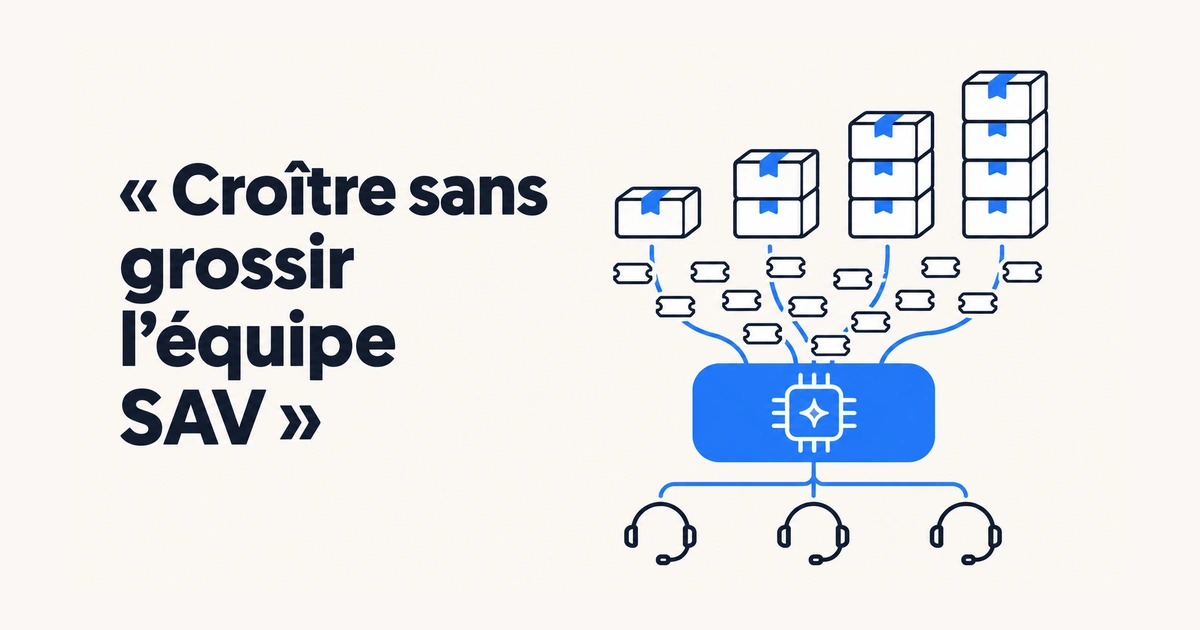
To absorb order growth without hiring in customer service, you need to break the link between order volume and the number of agents: the extra requests are handled by an AI that resolves them autonomously, while the team stays the same size. That is what NV Gallery, a furniture and home decor brand, did: it grew its revenue fourfold with the same support team, and Klark now automates around 70% of its interactions. Here is how to grow an e-commerce customer service team without hiring, with the figures and the method.
Key takeaways
- In e-commerce, tickets follow orders: without a change in how you organize support, every growth stage is paid for in new hires.
- NV Gallery grew its revenue fourfold without growing its support team; around 70% of its interactions are automated by Klark.
- At a fashion brand we work with, Klark handles 80% of the flow: 35% resolved autonomously, 45% with a reply drafted by Klark and approved by an agent.
- The calculation to run before hiring: how many requests could be resolved without human intervention?
Why does every growth stage cost you new hires?
A store that sells twice as much gets roughly twice as many questions: parcel tracking, returns, invoices, stock availability, order changes. The number of contacts per 100 orders stays fairly stable. If each agent handles a fixed number of tickets per day, the team has to grow at the same pace as sales.
Every hire costs more than a salary. You have to find the right person, train them on your processes and your brand voice, then manage them. Beyond a few agents, you need a manager, then a quality lead, then a scheduling tool.
The leaders we meet know this. In April 2026, the head of operations at a fast-growing e-commerce company told us why he was looking for an AI: "we're growing very fast, so if we do nothing, we see our support teams scaling very fast too. We may not want to make the same journey from 1 to 350 agents."
A month later, the founder of a beauty brand described the other side of the problem: in his view, "80% of their work could be automated very quickly so they can help customers buy." His concern: a team busy answering "where is my order?" instead of contributing to revenue.
How do you grow e-commerce customer service without hiring?
There are four options. They do not have the same effect on the link between volume and headcount.
| Option | Does cost follow sales? | Lead time | What it takes | Who it suits |
|---|---|---|---|---|
| Hiring agents | Yes, one for one | Several weeks per hire | Recruiting, training, management | Brands whose requests mostly need personal advice |
| Outsourcing (BPO) | Yes, per contact or per hour | Several weeks to a few months | Contract, tool access, control of brand voice | Brands that want to hand off support without running it day to day |
| Self-service (FAQ, tracking page, proactive emails) | No | A few days to a few weeks | Content kept up to date | All brands, as a complement |
| Autonomous AI resolution, with a copilot for the team | Very little: the automated share absorbs the increase | A few days of testing | Connecting the AI to the helpdesk and order tools, setting escalation rules | Growing brands with a high volume of recurring requests |
Self-service removes some avoidable contacts, but it cannot help a customer who wants to cancel an order or get an invoice. Autonomous resolution is what changes the equation.
How does Klark decouple growth from headcount?
Klark connects to your helpdesk (Zendesk, Gorgias, Freshdesk, Salesforce, Intercom, HubSpot…) and to your order tools. It learns from your past tickets and your knowledge base.
It then works on two levels:
- It resolves requests on its own, with or without an action in your tools: parcel status, return label, invoice, order cancellation. It does this over email and forms, on your website chatbot, and on the phone with the voicebot.
- It drafts the agent's reply for requests that go through the team: the agent reviews, adjusts if needed and sends. This is copilot mode.
When orders double, the share resolved by Klark absorbs most of the increase. The team keeps its size and spends its time on disputes, unhappy customers, pre-purchase advice and goodwill gestures.
At a fashion brand we work with, Klark handles 80% of the flow this way: 35% of requests are resolved autonomously, and 45% get a reply drafted by Klark and approved by an agent. If the brand opens new countries, the same logic applies to foreign languages, as we explain in our article on multilingual customer service.
What results did NV Gallery get?
NV Gallery sells furniture and home decor online. Its customers ask specific questions: manufacturing lead times, delivery of bulky items, damaged parcels, returns.
- Revenue multiplied by 4 with the same support team.
- Around 70% of interactions automated by Klark.
François, CEO of NV Gallery, sums up what it was like before: "We were drowning in repetitive tasks… until Klark."
These results are above the average we see across our customers (43% of tickets automated and +50% productivity). They depend on the share of recurring requests in your flow. You will find more results on our customers page.
How can you tell if your customer service can keep up with growth without hiring?
Before opening a position, run this three-step calculation. It is the one we do with every brand in our first conversation.
- Measure your contact rate: tickets for the month divided by the number of orders, multiplied by 100.
- Sort your tickets by reason and spot the ones that follow a clear rule: parcel tracking, returns, invoices, cancellations, product questions answered in the product page.
- Project your growth: apply the contact rate to your forecast orders and subtract the share the AI can resolve on its own.
Hypothetical example: a brand goes from 10,000 to 20,000 orders a month, with 12 contacts per 100 orders. Its tickets go from 1,200 to 2,400 a month. If half are resolved autonomously, the team handles 1,200 tickets, the same volume as before the growth.
How do you put it in place?
- Connect Klark to your helpdesk and your order and delivery tools.
- Let Klark draft replies for a few days in copilot mode: the team compares them with its own and adjusts the instructions.
- Turn on autonomous resolution for the most frequent request types, with clear escalation rules.
- Expand one request type and one channel at a time (email, chatbot, voicebot).
- Track each month the number of tickets handled per agent and the autonomous resolution rate.
Seasonal peaks are a good test: we tell how one brand got through Christmas 2025 with six times the usual volume and no extra staff in our article on Black Friday and sales peaks. For an overview of the tools, read our guide to AI for customer service.
Discover Klark
Ready to automate your customer service?
Find out what share of your requests Klark can resolve on its own, based on your own tickets.
Book a free demoFrequently asked questions
How can you absorb order growth without hiring in customer service?
A growing share of requests has to be resolved without human intervention. An AI connected to the helpdesk and order tools resolves parcel tracking, returns, invoices and cancellations on its own, and the team keeps the same size for the cases that need judgment.
What results did NV Gallery get with Klark?
NV Gallery grew its revenue fourfold with the same support team. Around 70% of its interactions are automated by Klark.
What share of requests can an AI handle in e-commerce?
Across Klark customers, 43% of tickets are automated on average. At a fashion brand, Klark handles 80% of the flow: 35% resolved autonomously and 45% with a reply approved by an agent.
Do you still need a customer service team?
Yes. The team handles disputes, unhappy customers, pre-purchase advice and goodwill gestures. The difference is that it no longer has to grow at the pace of orders.
How do you calculate the number of agents needed to keep up with growth?
Multiply your forecast orders by your contact rate to get the ticket volume, then subtract the share the AI can resolve on its own. Divide the rest by the number of tickets an agent handles per month to get the headcount you need.