
AI voicebot for e-commerce customer service: resolve calls with no waiting

A customer service voicebot is an AI that answers the phone, understands what the caller says and resolves the request during the call: order tracking, returns, nearest store, opening hours. When a request is out of scope or the customer wants to talk to someone, it transfers the call to an agent with a summary of the conversation, so nobody has to repeat themselves.
Key takeaways
- An AI voicebot holds a real conversation on the phone, where a traditional IVR offers a keypad menu.
- It resolves repetitive requests on its own (where is my order, returns, stores and opening hours) and transfers the rest to an agent, with the context.
- A voicebot's quality depends less on its voice than on what it can access: orders, carriers, returns tool, store list.
- The safest approach is to start with a pilot on a share of your calls, routed from your current IVR.
What is a customer service voicebot?
A customer service voicebot is a voice conversational agent connected to the brand's phone line. It transcribes what the caller says, works out the request, checks the brand's tools, then answers out loud with a synthetic voice.
You will come across three related terms. The IVR (interactive voice response) is the "press 1, press 2" menu: it directs calls but resolves nothing. The routing callbot understands a free-form sentence ("I want to speak to after-sales") and sends the call to the right queue. The resolution voicebot, the subject of this article, handles the request all the way through.
How does an AI voicebot handle a call, step by step?
A voicebot follows the same loop on every call. The step that makes the difference is almost always the last one: how the call ends.
- It picks up with no waiting, including evenings, weekends and end-of-year peaks.
- It understands the request in the caller's own words: "I ordered a sofa ten days ago and I haven't heard anything."
- It identifies the customer by the calling number or, failing that, by order number and postcode.
- It looks things up or takes action in the brand's tools: order status, parcel tracking, creating a return request, finding the nearest store.
- It wraps up or transfers: either the request is settled, or the call goes to an agent with a summary and the useful details, such as the order number.
Under the hood, every answer goes through a chain of four building blocks that run continuously, without waiting for the end of the sentence to get to work. A first model detects that the customer has finished speaking, a second transcribes their speech into text, a language model decides on the answer or action, then speech synthesis says it out loud. At Klark, this chain is agnostic about the language model: we pick the one with the best balance between quality and response time, and we can switch.
Which requests can a voicebot resolve on its own in e-commerce and retail?
A voicebot handles repetitive calls well when the answer sits in your tools. They are often the same as in your email inbox, so you can choose the voicebot's scenarios based on your written tickets.
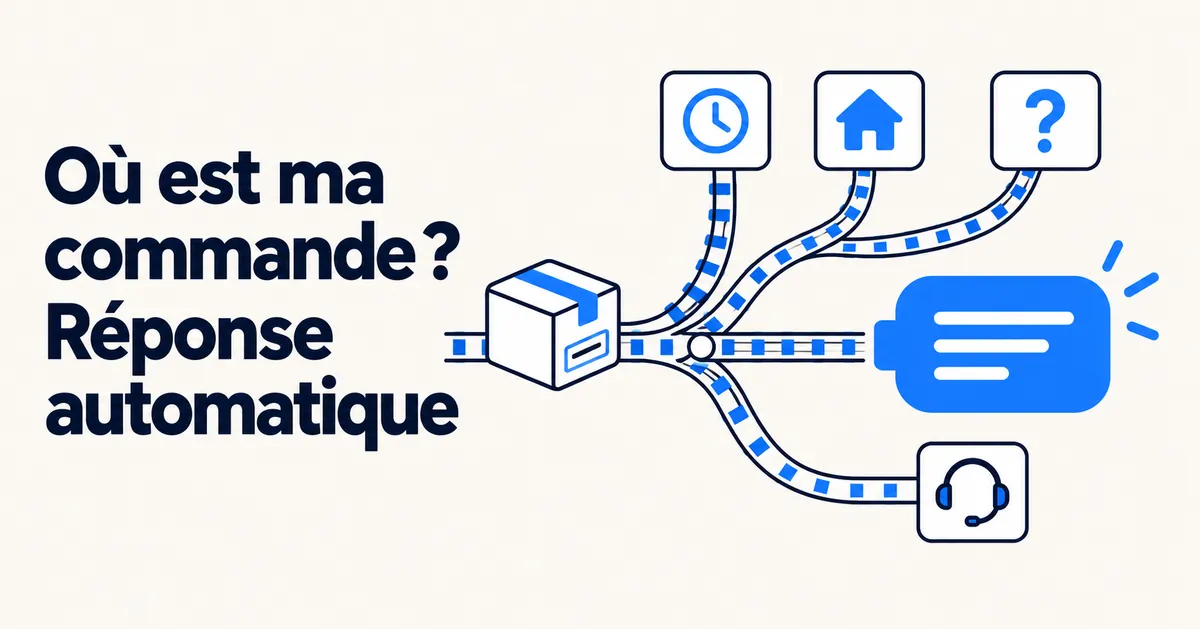
- Order tracking: "Where is my order?", "When will it be delivered?". The voicebot reads the status and the carrier tracking. The most common cases are covered in our article on automated answers to "Where is my order?".
- Returns and exchanges: eligibility check, then a return label, sent to the customer by email or text message during the call.
- Stores and opening hours: "What's the nearest store to me?", "Are you open tomorrow?". The voicebot calculates the distance and takes the day of the week and public holidays into account.
- Documents: resending an invoice to the customer's email address.
- Cancelling an order that has not shipped yet, according to your rules.
At Klark, the voicebot currently handles on its own the nearest store, opening hours (public holidays included) and order tracking. It also pre-qualifies after-sales requests: product type, purchase date, extended warranty. Because it already knows the customer's order history, this pre-qualification goes faster and the agent picks up a file that is already filled in.
What stays with an agent: very unhappy callers, disputes that need a commercial decision, and anyone who asks for a human.
Voicebot, IVR or routing callbot: which option for your customer service?
These three options do not meet the same need. The table below helps you choose based on your call volume and what you expect from the phone channel.
| Option | What it does | Who it's for | Limits |
|---|---|---|---|
| Keypad IVR | Directs the call through a menu | Few calls, with very different reasons | Resolves nothing, waiting time unchanged, customers annoyed by long menus |
| Routing callbot | Understands the request and sends it to the right queue | Call centers with several specialized teams | The agent still handles the call; the gain is in the sorting |
| Voice-only voicebot | Resolves requests on the phone | Brands whose main channel is the phone | One more setup to maintain, alongside the AI for written channels |
| Multichannel AI (written and voice), like Klark | Resolves requests by email, chat and phone with the same connections and the same rules | E-commerce and retail brands that get the same questions on every channel | Requires connecting your tools (orders, returns, stores) and defining transfer cases before launch |
How does the voicebot hand over to an agent?
A good transfer is prepared before launch. Three questions need settling with your telephony provider: how the call reaches the voicebot, how it leaves, and how the agent receives the context.
- Entry: a branch of your IVR forwards to the voicebot, through an external number or a SIP trunk. You can send only part of your calls there.
- Exit: the voicebot transfers the call to the right agent queue, not to the general switchboard.
- Context: the call summary and useful details appear in the agent's tool, for example the order number already verified.
At Klark, three triggers send the call to a human: a call that drags on, an explicit request from the customer, or a question the available knowledge cannot answer. The agent then receives a summarized, categorized record (reason, order number, summary of the conversation), for example in the banner of their telephony software. When the call goes to a store, the agent stays on the line until someone picks up, then states the reason and the order number, just as a human agent would. The customer has nothing to repeat.
Why use the same AI for written channels and the phone?
Because a customer who calls asks the same questions as a customer who writes. With two separate tools, you connect your systems twice, write your return rules twice and fix the same mistake twice.
Klark, used by more than 150 brands, already resolves written requests (emails, forms, website chatbot) by plugging into your existing helpdesk. Klark's voicebot reuses the same tools: order tracking, returns, store finder. Adding a capability on the phone means opening a tool that already exists for written channels to the voicebot, without recoding the business logic. Customer and order data already connected for written channels serve the phone with no extra development: only the phone connection depends on your telephony provider. For the big picture, see our guide to choosing customer service software and AI for e-commerce.
What we learned building Klark's voicebot
Moving from text to voice took four choices, drawn from our product team's work in November 2026.
- On the phone, every second counts. Latency is the first criterion: we constantly balance a natural-sounding voice against response time. The voicebot keeps its own conversation loop, optimized to answer fast, and only shares the tools with the rest of Klark. While it searches the tools, it says a holding phrase rather than leaving a silence.
- Some answers don't come from a knowledge base. "Is the nearest store open tomorrow?" means calculating a distance, knowing the day of the week and spotting a public holiday. We built a dedicated tool that reads a store table, rather than letting the AI search web pages.
- The brand name must be pronounced correctly. A synthetic voice can read a retailer's name as an ordinary word. We work on pronunciation upfront and test several voices by ear before each go-live. The brand chooses its voice from a catalog; cloning a brand voice is also possible, from about one hour of recordings.
- The pilot starts small. We scope pilots on a share of calls, routed from the brand's IVR, with a transfer to the agent that passes on the call's context.
The demand comes from the field. In a conversation in September 2026, the customer service manager of a home decor brand told us she was looking for an AI "that could take over for customers who need direct contact", especially for afternoon calls. And in November 2026, our sales team summed it up: "more and more partners are asking us to move into voice".
How much does a customer service voicebot cost?
The cost depends mostly on the billing model. There are three models on the market: per call minute, per call handled, or per outcome. The first two charge for volume, even when the call ends up with an agent.
At Klark, the model is the same for written channels and for voice. Success-based: you pay according to the help Klark actually provides on your tickets, with no per-agent license. For a quote tailored to your call volume, go through the demo request.
How long does it take to set up a voicebot?
The timeline depends less on the AI than on your telephony and your tools. These are the typical steps of a pilot.
- Choose two or three frequent call reasons based on your written tickets and your call statistics.
- Connect the tools needed: e-commerce platform, carriers, returns tool, store list.
- Set up call entry and exit with your telephony provider.
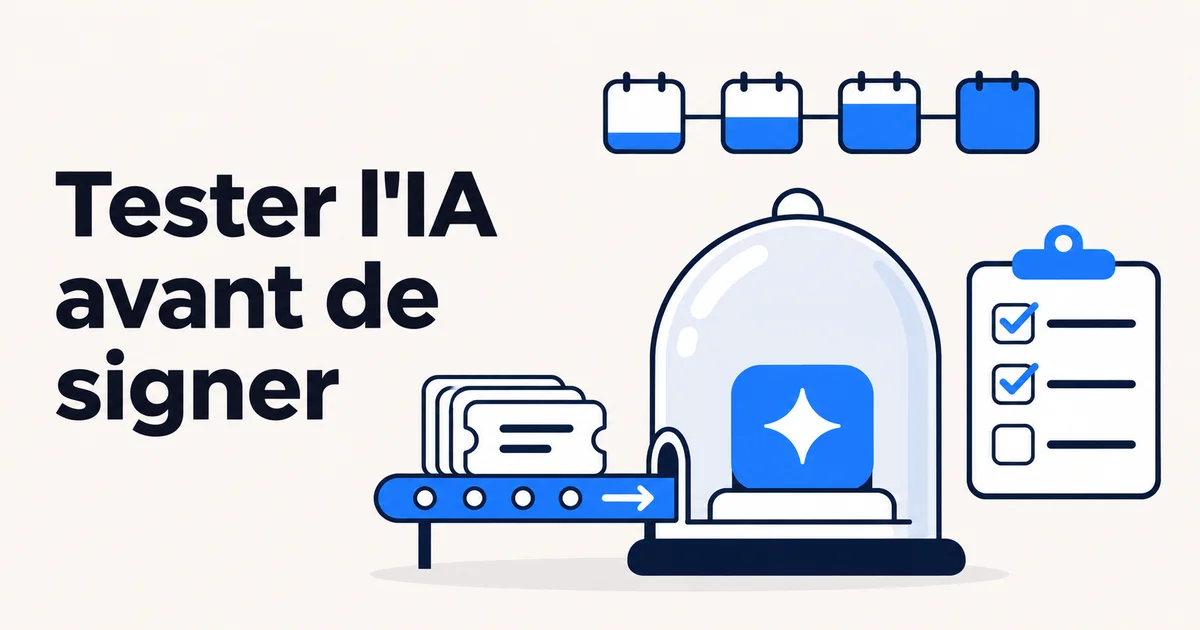
- Test with simulated calls, then open the pilot on a share of calls.
At Klark, a pilot starts on part of your calls, routed by a branch of your IVR, then widens based on the results. Our testing method is detailed in the article Testing a customer service AI for e-commerce: the pilot.
What are the risks of a voicebot, and which safeguards should you plan?
The first risk is a customer stuck in a conversation going round in circles. The safeguard is a simple rule: as soon as the customer asks for a human, or the voicebot is not sure of its answer, the call is transferred.
- Transparency: tell the customer at the start of the call that they are talking to an AI assistant. The European AI Act provides for this disclosure.
- Recording: if the call is recorded, the caller must be informed, as the CNIL (the French data protection authority) points out.
- Identification: the voicebot only gives information about an order after verifying the caller's identity.
- Accuracy: like Klark's chatbot, the voicebot only answers from validated knowledge, meaning the brand's public FAQ and the customer's data, and does not make things up. The FAQ is retrieved automatically and refreshed every week; connectors to your knowledge bases allow real-time updates. To talk to the customer, it relies on the customer FAQ, not on the agents' internal knowledge base.
- Scope: the voicebot only acts within the rules you have set (return window, which order statuses can be cancelled).
- Data: check where call data is processed and stored; it is often the first question from your DPO and CISO. At Klark, the whole chain, from speech recognition to the language model, runs in the European Union. Our commitments are on the security and GDPR page.
How do you measure a voicebot's results?
Measure resolution, not just the number of calls taken. Four indicators are enough to manage a voicebot.
- The rate of calls resolved without transfer, by call reason.
- The transfer rate, and the share of transfers requested by the customer.
- The repeat-call rate within 48 hours for the same reason: a "resolved" call followed by a callback wasn't resolved.
- Post-call satisfaction, compared with calls handled by an agent.
At Klark, the brand tracks these indicators in a console that also gives access to call transcripts and recordings. Your team can change an instruction there in plain language, then run test calls themselves to check the result. API and MCP access is coming soon.
Discover Klark
Ready to automate your customer service?
See how Klark resolves on the phone the requests it already handles in writing, and transfers the rest to your agents with the context.
Book a free demo →Frequently asked questions
What is the difference between a voicebot and a callbot?
Both terms describe an AI that talks on the phone, and they are often used interchangeably. "Routing callbot" is sometimes reserved for an AI that directs the call, and "voicebot" for one that resolves the request during the call.
Does a voicebot replace customer service agents?
No. It takes the repetitive calls, such as order tracking or opening hours, and transfers the others with their context. Agents spend more time on the calls that need judgment.
Can a voicebot work with my current phone system?
Yes, in most cases. A branch of your IVR sends part of your calls to the voicebot, through an external number or a SIP trunk, and the voicebot transfers to your agent queues when needed.
Where is voicebot call data processed?
It depends on the vendor, and it is a point to check with your DPO before any pilot. At Klark, speech recognition and the language model run in the European Union.
Do customers accept talking to an AI on the phone?
They do when the AI answers quickly and solves their request. What frustrates them is waiting, or not being able to reach a human. Announce the AI from the start and always offer a transfer to an agent.